
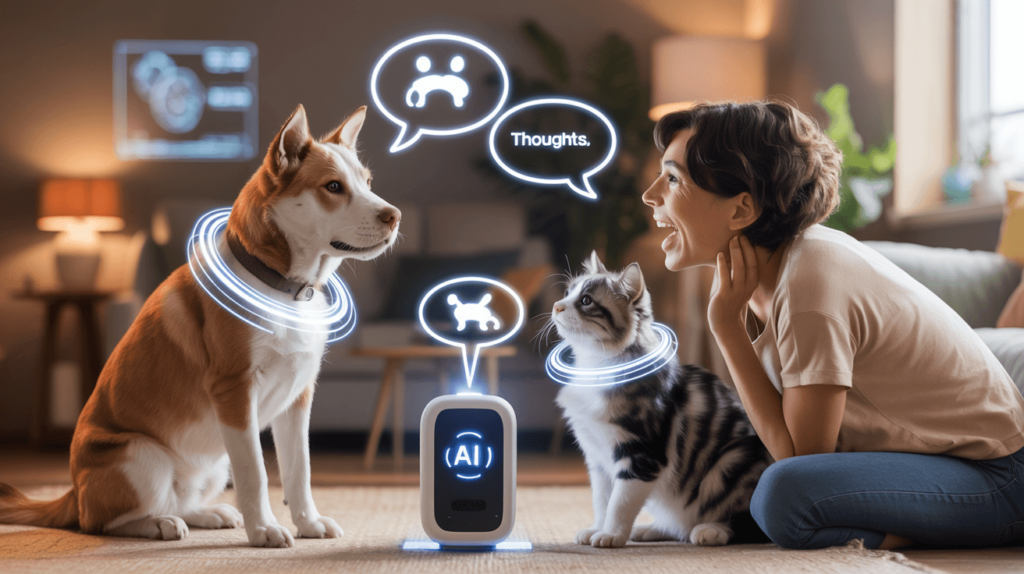
Exploring the Fascinating Possibility of Real-Time Animal Translation
Have you ever caught your dog staring at you with those earnest eyes and wondered, “What are you trying to tell me?”From a cat’s indignant meow at 5 a.m. to a parrot’s uncanny mimicry, animals clearly communicate just not in a language we easily decode. Artificial intelligence (AI) already bridges human tongues with apps that translate Mandarin to Spanish in a heartbeat. Could similar technology one day translate what your Labrador or cockatiel is “saying”?
This article unpacks:
- how animals actually communicate
- the ways AI might learn those signals
- cutting-edge projects attempting the first “pet dictionaries”
- hurdles scientists still face
- what true pet translation could mean for you and your furry (or feathery) companion
Whether you’re a lifelong animal lover or simply curious about the next tech frontier, read on.
1. Animal Communication 101
Before teaching a machine to interpret barks or purrs, researchers need to catalog what counts as “speech” in other species.
1.1 Multiple Channels
- Vocal – barks, meows, chirps, clicks
- Body Language – tail wags, ear position, feather fluffing
- Chemical – pheromones in ants, scent marking in dogs
- Vibration & Electrical – bee dances, electric fish pulses
“Communication isn’t just sound; it’s a multimodal orchestra.” – Dr. Con Slobodchikoff, animal behaviorist
1.2 Context Is King
A single bark means different things at the door versus during play. Any AI model must link signals to context time, environment, social setting—to avoid bad translations.
2. How AI Learns Languages (and Why Animals Are Harder)
2.1 The Recipe for Translation AI
- Huge, labeled datasets (millions of sentence pairs)
- Neural networks that find patterns and rules
- Continuous feedback to refine accuracy
Human languages supply step 1: billions of text samples. Animals do not.
2.2 Sparse & Noisy Data
- Individual pets vary widely. My beagle Buddy squeals when excited; a neighbor’s beagle barely whines.
- Body signals are subtle (the angle of a cat’s tail can change meaning).
- We can’t ask the “speaker” to verify: “Did you just say ‘food’?”
2.3 Emerging Tricks
- Self-supervised learning lets models find structure without labels—useful when no bilingual dictionary exists.
- Multimodal fusion merges audio, video, and environmental data, giving algorithms a richer picture.
3. Real-World Projects Trying to Crack the Code
3.1 Earth Species Project
Non-profit using self-supervised AI on baleen whale songs and primate calls. Goal: create an “animal Esperanto.”Source: https://www.earthspecies.org/
3.2 Petpuls Smart Collar
Commercial collar that analyzes dog barks to label five emotional states (happy, anxious, angry, sad, relaxed). Accuracy claims hover around 80 %. While not true sentence-level translation, it’s an early mood detector.
3.3 Bat, Prairie Dog & Bird Song Studies
- Bat Chat (Tel Aviv University) — algorithms identified individual Egyptian fruit bats’ arguments over food and roosting spots (Yovel Lab, 2021).
- Prairie Dog Alarm System — Dr. Slobodchikoff’s software distinguished alarm calls for different predators, sizes, even colors of human shirts.
- BirdNET (Cornell Lab of Ornithology) — crowdsourced AI that recognizes 3,000+ bird species by sound, a foundation for future “meaning” models.
4. Why Dogs and Cats Pose Special Challenges
4.1 Dogs
- Fewer distinct vocalizations than whales or songbirds; emphasis sits on body language and scent.
- Breeds differ anatomically, altering bark acoustics (compare a Huskie howl to a Pomeranian yap).
4.2 Cats
- Domestic cats meow primarily at humans, not other cats—an evolved “button-pushing” tactic.
- Purring can indicate pleasure, pain, or hunger; pitch and rhythm matter but are hard to quantify.
5. Potential Upsides of Accurate Pet Translation
- Better Welfare: sense stress before it manifests physically.
- Training & Enrichment: tailor games to what your dog says he enjoys.
- Veterinary Triage: early alerts when cats, masters of disguise, feel unwell.
- Therapy Animals: clearer dialogue between handlers and service dogs.
- Wildlife Conservation: detect distress calls in real time during environmental crises.
Imagine your phone buzzing: “Luna: My left paw hurts.” Early translation could shift vet visits from reactive to preventive.
6. Ethical & Practical Roadblocks
6.1 Risks of Misinterpretation
False positives could fuel unnecessary anxiety or cause owners to ignore real issues if the gadget reports “all good.”
6.2 Privacy & Exploitation
Continuous recording raises questions: who owns Rover’s data, and could it be sold for targeted pet-food ads?
6.3 Anthropomorphism
We may project human feelings onto animal messages (“I love you!”) when signals might be strictly utilitarian (“Give treat.”).
6.4 Access & Equity
High-tech collars could widen the gap between well-resourced pet parents and shelters already struggling.
7. How Close Are We?
| Milestone | Status | Estimated Timeline |
| Detect basic emotion (happy, stressed) | Early consumer products exist | Now |
| Recognize individual commands (“play”, “food”) | Prototype research | 3–5 years |
| Context-rich sentences (“I dislike the new kibble.”) | Experimental lab work | 10+ years |
| Two-way conversation | Speculative | Unknown |
Factors influencing the timeline:
- Hardware miniaturization for microphones & sensors that pets can comfortably wear
- Crowdsourced datasets (millions of pet interactions)
- Interdisciplinary teams merging ethology, linguistics, and AI engineering
Conclusion: The Day Our Pets Finally Talk Back
AI is edging toward a world where we grasp more than wagging tails and pleading eyes. Yet genuine pet “translation” demands huge, high-quality data, nuanced models, and rigorous cross-species research. While your next smartphone update won’t let you debate politics with your Siamese, incremental advances in emotion collars, wildlife call detectors, and smart litter boxes are already improving the lives of animals and humans alike.
So keep talking to your pets one day, thanks to AI and a lot of science, they might just talk back in a way we finally understand. Until then, the best translator is still patience, observation, and a handful of treats.