🚗🧭 Remember When You Had to Print MapQuest Directions?
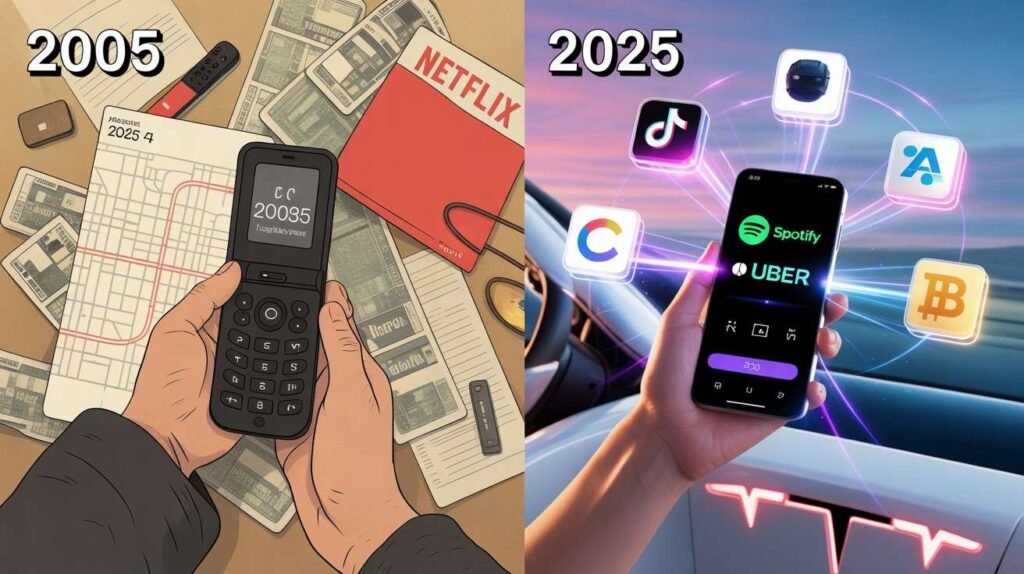
If you’re old enough to recall burning CDs for a road trip or printing directions from MapQuest, you’ve lived through a remarkable transformation. Just 20 years ago, this was the height of convenience.
Now? You’re likely streaming music on Spotify, getting GPS directions from your phone, paying for your Uber ride using cryptocurrency, and doing it all from a single handheld device while sipping your coffee.
In this blog post, we take a nostalgic yet eye-opening journey through the innovations that reshaped everyday life since 2005. From smartphones to social media, streaming, electric cars, and AI we explore how these once-futuristic concepts quietly became daily essentials.
1. 2005 in Rearview: What Everyday Life Looked Like
Communication & Entertainment
- Flip phones dominated, and only 7% of U.S. adults accessed the web on a mobile device (Pew Research, 2005).
- Text messages cost 25 ¢ apiece on many carriers, so you chose words carefully.
- Netflix arrived in red envelopes, mailing roughly 55 million DVDs that year (Netflix 10-K, 2006).
“If someone had described Spotify in 2005, I’d have assumed they owned a radio station in their pocket.” my older brother during a recent family dinner
Navigation & Travel
- Stand-alone GPS units were luxury items; most of us printed directions or bought atlases from gas stations.
- Flagging a taxi meant physically raising an arm on the curb.
Money & Work
- Paychecks arrived as paper.
- Offices still leaned on fax machines and cubicles; remote work tools were primitive or non-existent.
That context makes today’s conveniences feel nothing short of miraculous.
2. Pocket Revolution: Smartphones
iPhone’s Debut & Domino Effect
When Steve Jobs unveiled the iPhone in 2007, it fused phone, internet, and iPod into one slab of glass. By 2023, 85% of U.S. adults owned a smartphone (Pew Research).
Beyond Communication
Smartphones morphed into:
- Cameras replacing point-and-shoots
- Wallets via mobile payments
- Game consoles with cloud streaming
- Health trackers logging steps, sleep, even oxygen levels
Personal Note
I’ve used my phone as a boarding pass, heart-rate monitor, and remote car key all before morning coffee. Losing it feels like misplacing half my brain.
3. Social Media: Connection Re-Engineered
Instagram, Snapchat, TikTok All Post-2005
- Instagram (2010) turned photos into a language.
- Snapchat (2011) popularized disappearing messages.
- TikTok (2016) condensed entertainment into 90-second bursts heard ’round the world.
Cultural Shift
- Memory is now shared in stories and reels.
- Influencers became a career path; #ad is part of the lexicon.
Engagement Prompt
Do you scroll first thing in the morning? What would that slot in your routine look like without social feeds?
4. On-Demand Everything: From Rides to TV
Ride-Hailing & Delivery
- Uber (launched 2010) turned private cars into taxis via GPS and dynamic pricing.
- Food apps like DoorDash deliver pho, pizza, or groceries within an hour—services unheard of outside urban courier circles in 2005.
Streaming Supremacy
Netflix pivoted to streaming in 2007, followed by Spotify (2008). Physical media sales plunged; binge-watching and “playlist culture” were born.
- Roughly 80% of U.S. households subscribe to at least one streaming service (Statista, 2023).
What Got Replaced
- DVD players
- Broadcast TV schedules
- Car ownership in some cities
- Take-out menus on the fridge
5. Money Goes Digital: Bitcoin, Mobile Pay, & Fintech
Bitcoin’s Arrival
In 2009 Satoshi Nakamoto mined the genesis block; by 2024, the cryptocurrency market cap fluctuates near $1 trillion.
Everyday Transactions
- Apple Pay, Google Pay, and contactless cards rose after 2014.
- Peer-to-peer apps like Venmo and Cash App moved casual payments off crumpled bills.
A friend reimbursed me for concert tickets during the encore no ATM dash required.
Financial Inclusion & Risks
- Micro-investing apps made stock ownership possible with spare change.
- Volatility and scams remind us each leap in convenience carries new responsibilities.
6. Electric Dreams: Tesla & the Auto Renaissance
First Roadster to Full Model Line
Tesla sold its first car in 2008; by 2023, it delivered 1.8 million vehicles globally (Tesla Annual Report).
Infrastructure & Culture
- Charging stations outnumber some gas stations in major metro areas.
- Traditional automakers now release electric or hybrid versions of flagship models.
Beyond Battery
Self-driving features, over-the-air software updates, and subscription-based extras reframe what “owning a car” means.
7. AI Assistants & Everyday Algorithms
Voice at Your Command
- Siri (2011), Alexa (2014), and Google Assistant (2016) normalize speaking to machines.
- Smart homes adjust lights, thermostats, and locks through a simple phrase.
Recommendation Engines
Whether Netflix queuing your next series or Spotify’s Discover Weekly, AI curates an endless buffet of personalized content.
Workplace & Creative Tools
- Real-time transcription, grammar suggestions, and design templates accelerate output for solo entrepreneurs and large teams alike.
- Ethical debates over data privacy and job displacement grow louder, echoing concerns once held about industrial robots.
8. What Will We Laugh About in 2045?
If past pace holds, gadgets we cherish today could feel quaint in another twenty years. Possible candidates:
- Handheld phones replaced by ambient or wearable computing
- Physical screens yielding to mixed-reality lenses
- Typing passwords as voice or biometrics mature
Curious to see how future readers mock our present? Bookmark this post if bookmarks still exist.
Conclusion
From mailing DVDs to streaming 4K films, flagging taxis to summoning EVs, and flipping phones to swiping on glass slabs, everyday life has pivoted wildly since 2005. Each innovation began as a curiosity before embedding itself so deeply we now plan our schedules, finances, and friendships around it. The next breakthrough is likely incubating in a garage or code repository right now.
Takeaway: Enjoy today’s marvels, but keep a learner’s mindset because “can’t live without” might only be a software update away.