
When the Road Starts to Glow: Australia’s Night Driving Revolution
Imagine cruising through the Australian Outback under a moonless sky. The stars twinkle overhead, but the road ahead? Pitch black. Your headlights cut through the darkness, but only barely. Every bend holds a mystery. A kangaroo? A sharp curve? A sleepy mistake waiting to happen?
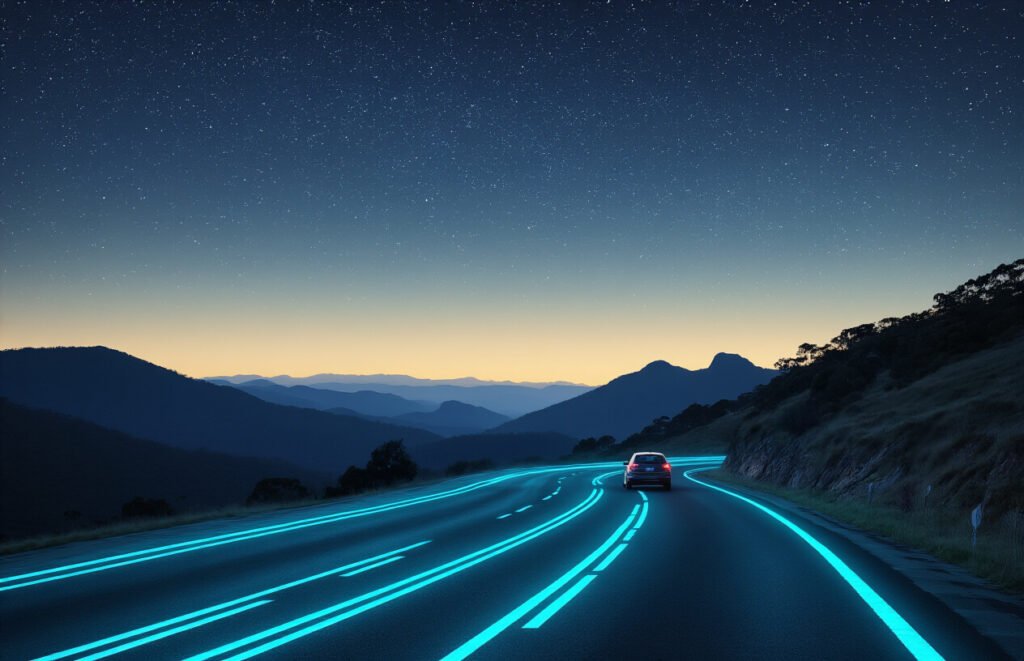
Now imagine those same roads transformed into glow-in-the-dark roads lined with soft, green, futuristic strips of light. They don’t need electricity. They don’t flicker. They simply shine, guiding you like a gentle runway into the night.
Sounds like a scene from a sci-fi movie? It’s not.
It’s the future of Australian road safety and it’s already rolling out.
“If the trials prove successful, we could see a future where long, empty stretches of highway guide drivers like airport runways—without a single power-hungry streetlight.” Mark Green, Senior Engineer, VicRoads (quoted in ABC News, 2024)
⚠️Why Night-Time Driving Is Still So Dangerous
Rural statistics that keep planners up at night
- According to the Australian Automobile Association, about 46 % of all road fatalities happen after dark, even though night-time traffic is considerably lighter.
- On rural highways, the figure climbs above 60 %. Limited lighting, higher speeds and wildlife crossings are key factors.
- Headlight range covers roughly 60–90 m on low beam; at 100 km/h you travel that distance in just 2–3 seconds.
The lighting gap outside the city limits
Installing conventional streetlights along every kilometre of remote road would cost billions in poles, wiring and ongoing electricity. Maintenance crews would need to visit far-flung sites frequently another expensive proposition.
How Do Glow-in-the-Dark Road Markings Work?
The science in plain English
Photoluminescent pigments—often based on strontium aluminate—act a bit like rechargeable batteries:
- Charging phase: During daylight, the pigment absorbs energy from the sun’s ultraviolet rays.
- Emission phase: After sunset, that stored energy is slowly released as visible light, typically a soft green or blue.
The paint is applied much like ordinary line-marking paint but with a clear protective layer to shield it from tyre wear and Australia’s punishing UV.
Visibility boost for drivers
Studies from the Netherlands (where similar markings debuted in 2014) show that photoluminescent lines can be seen from up to 800 m away on a clear night—four to five times further than retro-reflective paint illuminated only by headlights.
Inside Australia’s Pilot Projects
Victoria’s “Road Safety Innovation” trial
- Location: A 2 km section of the C class road between Ballarat and Lexton
- Partners: VicRoads, Tarmac Linemarking, and tech firm OmniGrip
- Timeline: Applied in late 2023, monitored for three years
- What’s measured: Luminance decay through the night, crash statistics, driver feedback
Queensland’s Bruce Highway upgrade
Queensland’s Department of Transport is painting exit chevrons and merge arrows near Townsville to gauge how well the pigments perform in tropical humidity and intense summer sun.
Driver Sarah Coleman told local radio,“I noticed the lines glowing before my headlights even reached them felt like I was following a gentle runway. It definitely reduced the strain on my eyes.”
Potential Benefits Beyond Better Visibility
1. Safety gains
- Greater preview time for drivers means earlier braking or steering corrections.
- Clearer lane guidance can reduce fatigue and “white-line hypnosis.”
- Wildlife collisions may drop because motorists see wandering animals sooner.
2. Energy and carbon savings
No streetlights = no electricity bills in remote regions. Even solar-powered lighting incurs battery and hardware costs.
3. Maintenance efficiency
Line-marking crews already repaint lines periodically; swapping to photoluminescent paint piggybacks on existing schedules rather than adding new infrastructure.
4. Tourism & amenity
Anecdotally, some local councils are excited by the idea of “glowing tourist drives,” encouraging safer night-time travel between regional towns.
Challenges and Open Questions
Durability under harsh Australian conditions
- Will desert dust or coastal salt weaken the glow?
- Early data suggest a usable glow for 8–10 hours after full daylight charge, but long-term degradation still needs study.
Cost versus traditional paint
- Photoluminescent paint is 3–4 × more expensive up front. Officials hope economies of scale and reduced lighting costs will balance the ledger.
Driver adaptation
There’s little risk of distraction, but authorities are checking whether a glowing road surface might conflict with existing retro-reflective signage.
What Other Countries Have Tried
| Country | Project | Key Takeaway |
| Netherlands | N329 ‑ Oss “Smart Highway” (2014) | Initial glow faded faster than expected; reformulated pigments improved longevity. |
| USA | Texas “NightBright” lane dots | Used sealed resin inserts; promising but pricey. |
| UK | London’s “Cycle Superhighway” | Photoluminescent bike lanes aided commuters and e-scooters without extra lighting. |
Could This Come to a Road Near You?
Steps local councils are already considering
- Identify crash-prone dark corridors under 100 km in length.
- Conduct small-scale trials on one lane to gather feedback.
- Combine glowing edge lines with raised reflective pavement markers for maximum guidance.
If you’re part of a community group or road safety committee, ask your council whether funding under the federal Black Spot Program can be allocated to photoluminescent trials.
A Brighter, Safer Road Ahead
Glow-in-the-dark road markings sound almost whimsical, yet the idea is rooted in solid physics and real-world safety data. Early Australian trials suggest they can:
- Improve night-time visibility dramatically
- Reduce the need for costly, carbon-heavy streetlights
- Deliver quicker safety wins in remote areas where traditional infrastructure lags
As monitoring continues over the next few years, keep an eye on the Ballarat–Lexton corridor and similar test sites. If the luminous lines hold up under Australia’s sun, dust and rain, your next outback road trip might be guided by a ribbon of gentle green light—helping you see further, drive safer, and maybe even enjoy the midnight landscape a little more.
Road safety isn’t always about bigger barriers or brighter headlights. Sometimes it’s as simple as letting the road itself shine.