Introduction
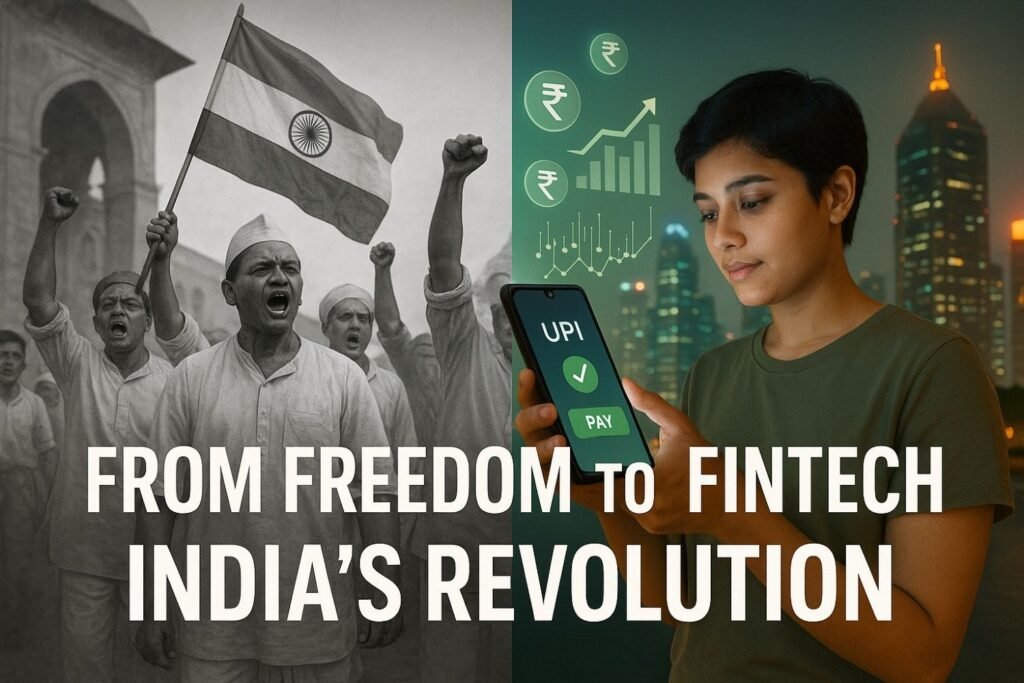
“An idea whose time has come,” Jawaharlal Nehru declared at the stroke of midnight on 15 August 1947. Fast-forward seventy-plus years and another idea: instant, mobile-based payments are quietly re-shaping daily life for more than a billion people. How did a nation that once wove homespun khadi in defiance of an empire become the poster child for friction-less finance? This article follows India’s arc from colonial resistance to digital renaissance. We will:
- Revisit key milestones of the freedom struggle that seeded economic self-belief.
- Examine post-independence policies that prepared the ground for innovation.
- Explore the 1991 liberalisation that opened floodgates for capital and code.
- Unpack the public-digital infrastructure (Aadhaar, India Stack, UPI) powering today’s fintech successes.
- Identify challenges and opportunities that lie ahead.
“In less than a decade, India has moved from cash-first to cash-last mindsets—an evolution as sweeping as the move from Empire to Republic.”
The Embers of Freedom: 1857–1947
A Colonial Economy Primed for Rebellion
While textbooks rightly highlight political oppression, economic exploitation was equally potent fuel for resistance. British policies:
- De-industrialised Indian textiles, reducing India’s share of global cloth exports from roughly 25 % in 1800 to under 2 % by 1900 (Cambridge Economic History).
- Imposed high salt and cloth taxes, turning everyday items into symbols of subjugation.
- Redirected agricultural output to serve British mills, triggering periodic famines.
Swadeshi & Economic Self-Determination
The 1905 Swadeshi Movement urged Indians to boycott foreign goods and “buy Indian.” Spinning wheels appeared in courtyards not as nostalgic props but as direct economic action. The lesson was clear: controlling the purse strings could challenge political power.
“We will bring industry and agriculture as close to each other as lips and teeth.” — Mahatma Gandhi, 1931
Blueprint for Financial Inclusion
Freedom leaders envisioned village-level co-operatives and indigenous banking—early echoes of today’s microfinance and fintech ambitions.
Building the Foundations: 1947–1980s
Nation-Building via Heavy Industry
Post-independence planners, inspired by Soviet models, prioritised:
- Steel plants in Bhilai, Rourkela, Durgapur
- Dams dubbed “temples of modern India”
- Public-sector banks expanding branches from ~8,000 in 1969 to over 60,000 by 1990 (RBI data)
While bureaucratic, this phase created:
- Human-capital pools of engineers
- A culture of state-supported risk-taking
Green & White Revolutions
By introducing high-yield seeds (Green Revolution) and co-operative dairies (White Revolution), India progressed from “ship-to-mouth” grain imports to food security freeing fiscal space for future tech spending.
1991: Liberalisation That Rewired the Economy
The Crisis Nobody Could Ignore
In June 1991, forex reserves sank to cover just three weeks of imports. Gold was literally air-lifted to London as collateral. This cliff-edge moment pressed policymakers to open markets.
Reforms in a Nutshell
- De-licensing industries
- Reducing import tariffs from 300 %+ to double-digits
- Allowing 51 % foreign equity in many sectors
- Rupee devaluation boosting exports
IT Services India’s First Global Tech Brand
Nurtured by a large English-speaking workforce and satellite links, firms like Infosys and Wipro turned code into currency, laying cultural groundwork for fintech talent.
Digital Public Infrastructure: Laying the Rails
Aadhaar: One ID to Rule Them All
Started in 2009, Aadhaar provides biometric identity to 1.3 billion residents crucial for KYC (Know Your Customer) compliance. Subsidy leakages dropped; banks could onboard customers in minutes, not weeks.
India Stack: Open APIs, Open Possibilities
- e-KYC: Paperless, consent-based identity verification
- e-Sign: Legally valid digital signatures
- DigiLocker: Cloud vault for certificates
- Account Aggregator Framework: Unified view of financial data
Unlike many Western counterparts, the rails are public, the innovation private.
FinTech Takes Center Stage
Unified Payments Interface (UPI): The Crown Jewel
Launched in April 2016 by the National Payments Corporation of India (NPCI):
- Facilitates peer-to-peer and peer-to-merchant transfers via mobile numbers or “handles” (@ybl, @okaxis).
- Processes over 10 billion transactions each month as of August 2023 (NPCI statistics).
- Costs near-zero to consumers and merchants, undercutting card fees.
Start-ups, Unicorns & Everyday Impact
- PhonePe, Paytm, Razorpay each now process billions in monthly volume.
- Rural kirana stores accept QR codes, bridging cash corridors.
- Insurtech (Policybazaar), WealthTech (Groww) expand beyond metros.
Quick Stat Box• 338 million Jan Dhan bank accounts opened since 2014• 67 % of them active (World Bank Global Findex 2021)• Mobile data cost: ~$0.17/GB, world’s cheapest (Cable.co.uk, 2023)
Government as Early-Stage Customer
Schemes like Direct Benefit Transfer (DBT) pushed billions directly into bank accounts, stress-testing payment rails and giving private players confidence to scale.
Inclusivity at Scale: Why It Matters
The Gender Dividend
Studies by the International Monetary Fund suggest closing India’s gender gap in mobile-based payments could add 6 % to GDP by 2025.
Small and Medium Enterprise (SME) Credit
Account Aggregators let SMEs share GST invoices securely, helping fintech lenders underwrite loans in hours rather than weeks.
Personal Anecdote
When my 68-year-old aunt in a tier-3 town sold homemade pickles last Diwali, she shared a QR code on WhatsApp. Payments arrived instantly, and her first digital credit offer followed within days proof that inclusion is no longer a buzzword.
Challenges on the Horizon
1. Cybersecurity
- Phishing and social-engineering scams target first-time users.
- Need for widespread digital literacy campaigns.
2. Regulatory Balancing Act
- Data-protection bill must walk the tightrope between user privacy and innovation.
- Stablecoin and crypto guidelines remain in flux, affecting cross-border payments.
3. Last-Mile Connectivity
- 4 G coverage is broad but patchy in some Himalayan and tribal regions.
- Sat-com and 5 G rollouts could be game-changers.
Conclusion: The Next Freedom Struggle Economic Empowerment
India’s story from khadi to code illustrates that revolutions are rarely overnight events; they are tapestries woven from countless threads policy choices, public will, and a healthy dose of serendipity. The same spirit that spun charkhas in defiance now spins data packets at light speed, empowering citizens to transact, save, and invest with unprecedented ease.
The takeaway?Fintech isn’t merely an industry; in India, it’s the continuation of the freedom movement by other means democratising finance so every citizen enjoys independence over their economic destiny.
Have a thought on how UPI or Aadhaar has impacted your life? Share your story in the comments history, after all, it is crowdsourced.