
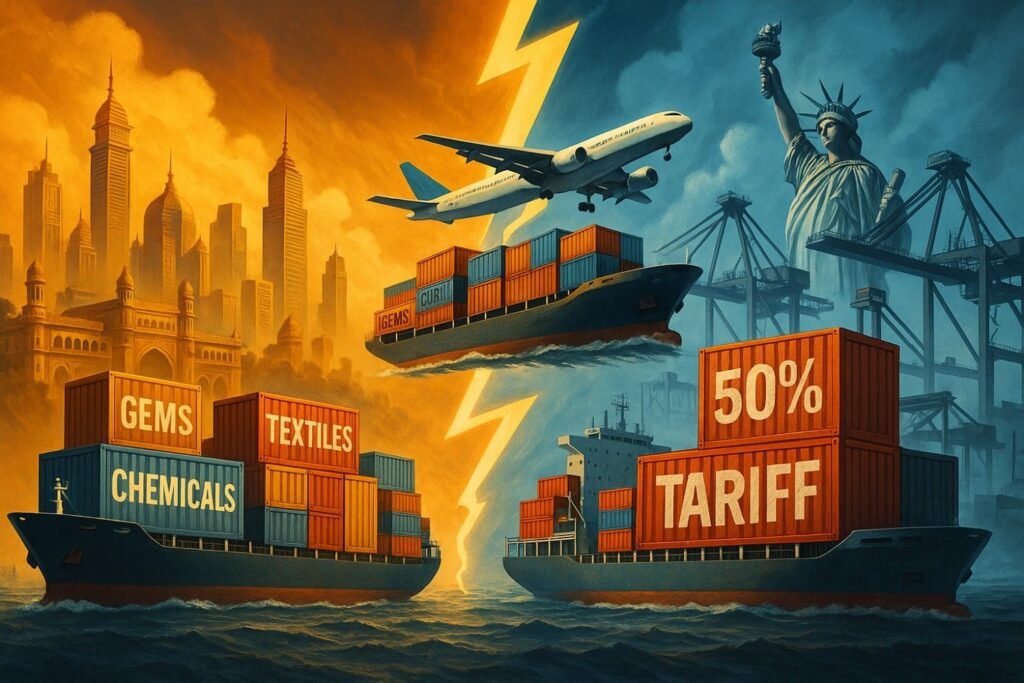
Imagine this: You wake up to headlines screaming about a 50% tariff on Indian exports to the US. Panic sets in for exporters, investors, and business owners. Will this be the knockout punch for India’s trade engine? Or just another storm the country learns to dance in?
Welcome to the latest chapter in global trade drama where political power plays, strategic diplomacy, and India’s economic grit collide. Let’s unpack how India is responding, adapting, and in some cases… turning these tariffs into opportunities.
1. Trump’s 50% Tariff Shockwave – What It Means for India
A. From 25% to 50% – The Big Jump
US President Donald Trump’s tariff hammer has landed hard: a 50% levy on Indian goods doubling the previous 25% rate. The official reason? India’s ongoing oil trade with Russia, which Trump labeled a “strategic concern.”
The new tariffs will take effect in 21 days, a small but critical window for diplomacy. As Brian Jacobsen of Annex Wealth Management puts it, this is “quite a wide window to provide an offramp” before things escalate further.
B. Who’s Feeling the Heat?
Not every industry will feel the burn equally. While 20% of India’s exports head to the US, only some sectors are in the direct line of fire:
- Gems & Jewelry 💍
- Apparel & Textiles 👗
- Chemicals 🧪
On the other hand, key sectors like IT services, pharmaceuticals, semiconductors, and Apple’s India operations remain untouched — offering some stability amidst the chaos.
C. The Ripple Effect on GDP
Economists had initially predicted minimal impact from the 25% tariffs, but at 50%, the stakes rise. Fortunately, India’s Nifty 50 has just 9% direct US exposure, largely in IT untouched by the goods tariff. The bigger challenge? A weaker rupee and more currency volatility, which could rattle foreign investments in the short term.
2. India’s Game Plan – Playing Chess, Not Checkers
A. Diplomatic Moves in the 21-Day Window
New Delhi is already working the phones. The focus?
- Emphasizing the US–India strategic partnership
- Highlighting joint military exercises and defense collaborations
- Reminding Washington of the mutual benefits in trade and tech investments
B. Retaliation or Redirection?
If diplomacy stalls, India could:
- Slap counter-tariffs on US goods
- Accelerate free trade agreements recent deals with the UAE, Australia, EFTA, and UK show India is serious about diversifying markets
- Offer incentives for vulnerable sectors like textiles, gems, and seafood exports
C. Balancing the Russia Equation
The so-called “oil penalty tariff” puts India in a tricky spot balancing energy security with diplomatic relations. Any misstep could hurt either its domestic economy or foreign partnerships.
3. Resilience on Display – Why India Isn’t Folding
A. The “China-Plus-One” Advantage
Even with tariffs, India’s role as a manufacturing alternative to China is growing. Big-ticket investments prove it:
- Google: $6B data center in Andhra Pradesh (2025)
- Foxconn: $1.48B expansion in India
- Foxconn-HCL: $430M electronics plant approval
- iPhone Exports: 39M units in Q2 2025 (7% YoY growth)
B. Sectors That Are Safe (For Now)
- Pharmaceuticals & Electronics remain untouched
- Electronics now make up 22% of total merchandise exports, double last year’s share
C. Short-Term Wins for Exporters
- Stockpiling rush from US buyers before tariffs hit
- Exports to the US up 25% YoY in early 2025
- Frost & Sullivan ranks India #3 globally for withstanding trade and tariff shocks
Navigating the Future
Trump’s proposed 50% tariffs represent a significant challenge for India, but the nation’s economic resilience and diversified export strategy position it well to weather this potential storm. While certain sectors may face immediate pressures, India’s growing domestic market and strategic partnerships provide important buffers against external shocks.
As India stands at this geopolitical crossroads, balancing relationships with the US and Russia becomes increasingly crucial. For investors and businesses, understanding these dynamics offers valuable insights into India’s economic trajectory. The coming months will test India’s diplomatic acumen and economic adaptability, but history suggests India possesses the strategic patience and flexibility to navigate these complex waters while continuing its growth story.