
Introduction
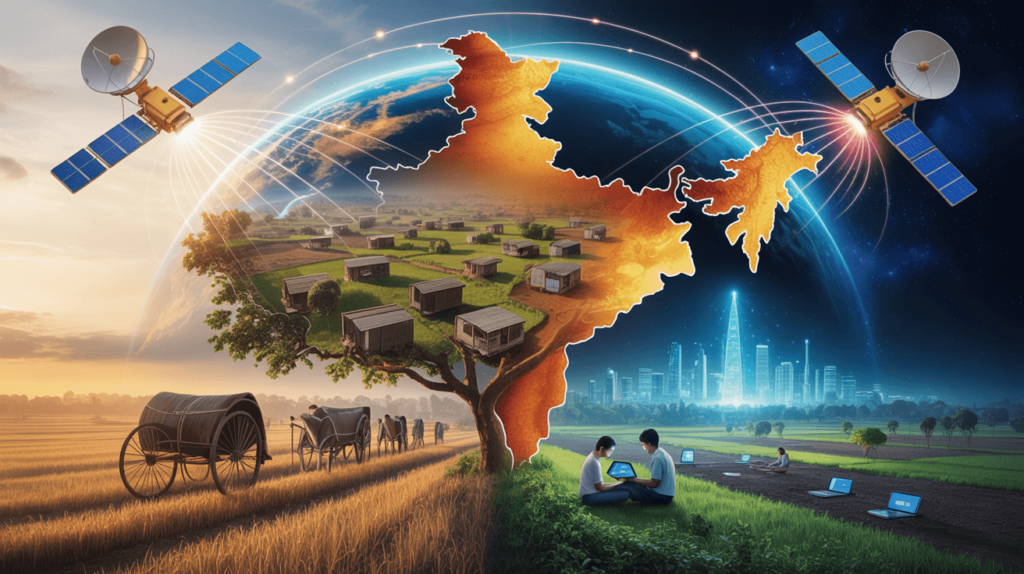
Late last night my phone buzzed with a text from a friend teaching in rural Solapur:“Net’s down again. Kids can’t access the e-class.”Hours later the Government of Maharashtra dropped a bombshell an official Letter of Intent (LoI) with Elon Musk’s Starlink Satellite Communications Pvt. Ltd. to beam internet straight from space to every corner of the state. This single announcement, made on 5 November 2025, positions Maharashtra as the first Indian state to formally tap a constellation of 4,000+ low-Earth-orbit (LEO) satellites for public services.
1. Decoding the Letter of Intent
1.1 Key Clauses at a Glance
- Coverage mandate: 100 Mbps downlink to every gram panchayat by December 2027
- Pilot phase: 1,500 sites across Gadchiroli, Nandurbar, Raigad, and Latur districts within six months
- Priority sectors:
- Government schools and skill centres
- Primary Health Centres and tele-medicine hubs
- Disaster management offices and coastal radar stations
- Pricing model: Concessional bandwidth rates fixed for five years; capital cost of user terminals co-shared (60 % state, 40 % Starlink CSR fund)
- Make-in-Maharashtra clause: Assembly of 20 % of user terminals at MIDC Pune by 2026
“Space-based connectivity is no longer a luxury add-on; it’s core infrastructure like roads or power lines.”—Excerpt from the LoI preamble, Government of Maharashtra
The document, publicly released on the state ICT portal, falls short of a full contract but sets the negotiation table. According to officials, a definitive agreement is targeted for March 2026, pending regulatory clearances from the Department of Telecommunications (DoT) and IN-SPACe.
1.2 Why Maharashtra Moved First
- Largest state GDP in India: Strong balance sheet to subsidise pilot costs
- Varied geography: From the Sahyadri ranges to the Konkan coast ideal test bed
- Political will: Digital Maharashtra 2030 blueprint already flagged “satcom backhaul” as a priority
- Recent cyclone Tauktae (2024) revealed gaps in emergency connectivity along the coast
2. Satellite Internet 101: Clearing the Fog
Most of us still picture bulky dishes and three-second lag when we hear “satellite internet.” LEO systems like Starlink flip the script:
2.1 How LEO Networks Work
- Altitude: 550 km vs. 36,000 km for traditional geostationary satellites
- Constellation: Thousands of small satellites providing overlapping coverage
- User Terminal: Pizza-box-sized phased-array antenna, auto-aligns to passing satellites
- Latency: 20–40 ms (comparable to 4G), a game-changer for video calls and cloud apps
2.2 Fibre vs. 5G vs. LEO
| Parameter | Optical Fibre | 5G (terrestrial) | LEO Satellite |
| Upfront CapEx/km | High (trenches, ducts) | Moderate (towers) | Low (terminal only) |
| Time to Deploy | Slow—permits/ROW | Medium | Very Fast |
| Performance in Cyclones | Vulnerable (cable cuts) | Tower outages | Weather-resilient |
| Reach in Hilly/Forest Areas | Limited | Patchy | Unaffected by terrain |
Satellites are not a silver bullet, but they excel where ground networks hit a wall—literally.
3. Potential Impact on Public Services
I spent part of 2023 mentoring a digital literacy camp in Melghat. Students walked 5 km to reach one of the two places with stable internet. Here’s how Starlink endpoints could shake things up:
3.1 Education: Beyond Downloading PDFs
- Live two-teacher model: Urban specialist + local facilitator in remote classrooms
- Cloud labs: Students run Python code in real time without hefty laptops
- Digital libraries: 24/7 access to NCERT and state board resources
Starlink Brazil’s 2022 pilot saw rural students gain 33 % higher attendance. Maharashtra hopes for similar traction.
3.2 Healthcare: The Last-Mile Stethoscope
- Tele-radiology: Upload a CT scan in minutes instead of couriering CDs
- e-ICUs: Remote monitoring by tertiary hospitals in Mumbai or Pune
- Vaccine cold-chain monitoring: IoT sensors stream temperature every 60 seconds
3.3 Agriculture & Fisheries
- Precision farming dashboards: Weather and soil data in near real-time
- e-Mandi access: Farmers check spot prices before heading to the market
- Coastal alerts: Faster cyclone and tsunami early-warning messages
4. Challenges No Press Release Mentions
4.1 Regulatory Speed Bumps
- Spectrum licensing: DoT is still finalising guidelines for Global Mobile Personal Communications by Satellite (GMPCS).
- Data sovereignty: Government demands in-country ground stations; Starlink currently teleports traffic to Singapore.
- Security audits: Indian Space Research Organisation (ISRO) will scrutinise potential interference with remote-sensing missions.
4.2 Affordability & Subsidy Design
Starlink’s retail kit, priced at roughly ₹45,000 plus ₹7,000 per month, is beyond most rural budgets. The LoI proposes a blended model:
- State subsidy for priority institutions
- Community Wi-Fi sharing to amortise cost
- Tiered pricing for individual households once coverage scales
4.3 Supply-Chain & Weather Concerns
- Terminal imports currently attract 20 % customs duty.
- Sea salt corrosion along Konkan coast requires ruggedised hardware.
- Monsoon cloud density can degrade Ku-band signals, although early tests show <5 % packet loss.
Callout: Starlink’s recent switch to E-band downlinks could reduce rain fade by up to 60 %, according to a 2025 study by the European Space Agency.
5. Timelines & What to Track Next
5.1 Proposed Roll-Out
- Q1 2026: Regulatory approvals; ground station near Nagpur operational
- Q2 2026: 1,500 pilot sites live
- Q4 2026: Independent impact audit; decision on state-wide expansion
- 2027–2028: Full coverage to 40,000+ gram panchayats
5.2 Key Warning Lights
- Delays in customs and local manufacturing could push back deadlines.
- Competing satcom entrants (OneWeb, Amazon Kuiper) may contest spectrum allocations, causing legal gridlock.
- National tariff policy still unclear on Universal Service Obligation (USO) fund eligibility for satellite projects.
Conclusion
A century ago, Maharashtra’s coasts exported cotton on steamships. Today the state looks skyward, betting on swarms of satellites to export knowledge inward to its own villages. If the LoI matures into a working network, a teacher in Solapur may soon finish her lesson without “net’s down again” interrupting the class.
The coming months will test regulatory agility, fiscal prudence, and technical grit. Citizens, policymakers, and tech enthusiasts alike should keep a close watch on pilot performance data, especially uptime, speed, and community usage patterns.
Curious what satellite internet feels like on the ground? Share your questions in the comments or read our deep dive into “Is LEO the Future of BharatNet?” over on our Digital Bharat series.
Let’s keep the conversation open whether through fibre, 5G, or a beam of light bouncing off a moving metal box 550 km above us.