
Introduction
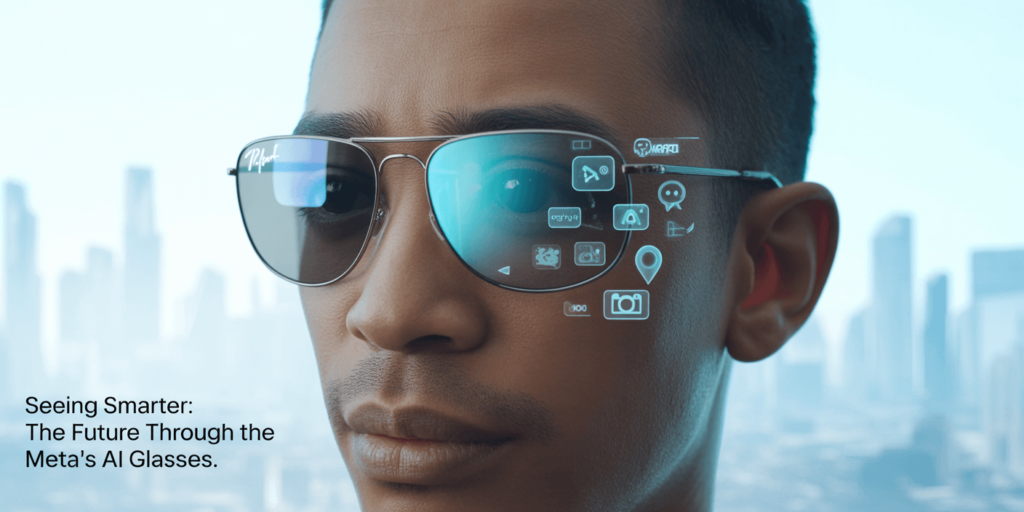
Have you ever noticed how wearable tech has quietly become part of our everyday lives? From wireless earbuds to fitness trackers, it’s everywhere seamlessly blending into our routines. Now, Meta (the company behind Facebook, Instagram, and WhatsApp) wants to take that integration one step further with its AI-powered smart glasses.
These aren’t just sunglasses with a camera. They’re designed to make your world more interactive and maybe even a little smarter.
Let’s explore what makes Meta’s new smart glasses so different from their design and features to their AI intelligence and privacy implications.
1. From Google Glass to Today: A Short History of Smart Specs
1.1 The early experiments
- 2012 – Google Glass: Ambitious but bulky, with a glowing prism that shouted, “I’m filming you.”
- 2016 – Snap Spectacles: Focused on short video clips for Snapchat, but no built-in assistant or display.
- 2021 – Ray-Ban Stories (Meta’s first try): Added dual cameras and open-ear audio yet relied heavily on a paired phone.
“Good hardware is invisible,” Meta Reality Labs VP Andrew Bosworth likes to say. The company’s new release doubles down on that mantra.
1.2 Why Meta stayed the course
Despite modest sales, Ray-Ban Stories taught Meta two lessons:
- Frames must look and feel like regular eyewear.
- Users want hands-free capture plus something truly new AI.
2. Hardware Highlights: What’s Actually on Your Face?
2.1 Design tweaks
- Built in partnership with Ray-Ban, available in Wayfarer, Headliner, and the new cat-eye-inspired “Skyler” style.
- Lighter hinge materials shave about 5 g off the previous model.
- Prescription-lens option at launch (U.S. only for now).
2.2 Camera & audio upgrades
- 12-MP ultrawide camera (up from 5 MP) for 1080p 60 fps video.
- A five-microphone array enables spatial audio and clearer voice commands in a busy street.
- Custom “micro-speaker” drivers offer louder playback with less leak—think mini personal speakers aimed at your ears.
2.3 Battery & charging
- Roughly four hours of continuous use; the included carrying case doubles as a portable charger for up to eight additional charges.
- USB-C port on the case; no proprietary cables required (finally).
Full spec sheet on Meta’s newsroom.
3. The Secret Sauce: AI Inside the Frame
3.1 Multimodal Meta AI
Instead of just taking photos, the glasses run Meta AI, a lightweight language-and-vision model tuned for on-device tasks:
- Identify objects (“What tree is that?”)
- Translate printed text in real time
- Offer navigation hints (“Which way to the subway?”)
When Wi-Fi or 5G is available, complex queries route to Meta’s cloud to tap larger models. If not, basic recognition still works offline.
3.2 Voice control without a wake word
A gentle touch on the temple activates the assistant. Meta found many users disliked shouting “Hey Facebook” in public, so taps and gestures take center stage.
3.3 Learning locally
- Personalized commands like “Call Mom” are stored on your phone, not Meta’s servers.
- Over time, the glasses adapt to your routine (e.g., surfacing the weather every morning when you step outside).
4. Everyday Use Cases: Beyond Selfies
4.1 Travel
- Live captioning for museum plaques or foreign menus.
- Hands-free Google Maps integration (rumored for a future software update).
4.2 Work & study
- Voice-to-text note-taking during lectures.
- Quick photo reference for remote field workers—imagine an electrician streaming what they see while a senior engineer guides them.
4.3 Content creation
Creators can start an Instagram or Facebook Live just by saying, “Go live.” No juggling phones or gimbals.
“The less gear I have to carry, the more authentic the moment feels,” says travel vlogger Sofia Nguyen, part of Meta’s early-access group.
5. The Inevitable Privacy Conversation
5.1 Visible recording indicator
A small LED near the right lens blinks while filming. Critics argue it’s too tiny; Meta counters that making it larger would drain the battery and draw unwanted attention to the wearer.
5.2 Data retention
- Photos and transcripts are stored in the Meta View app, where users can set auto-delete intervals from 24 hours to 30 days.
- Opt-in “AI improvement” setting lets Meta review anonymized clips—off by default in the EU due to stricter regulations.
5.3 Bystander consent
European consumer groups have called for clearer markings on the frames. Meta says it’s open to region-specific hardware tweaks.
6. Rivals & Market Impact
6.1 Apple, Google, and Samsung
- Apple’s rumored “Vision Lite” headset focuses on mixed reality rather than all-day wear.
- Google is quietly testing AR translation glasses but hasn’t announced a release date.
- Samsung and Qualcomm plan a joint AR platform by 2025.
6.2 Pricing pressure
Meta’s glasses start at $299 the same ballpark as premium sunglasses plus earbuds. Competitors may have to cut margins or bundle services to match.
6.3 Developer opportunities
Meta opened an Early Access SDK enabling:
- Computer-vision apps for plant identification.
- Contextual audio tours for tourist spots.
- Real-time sports stats overlays (once displays are added in future versions).
7. What It Means for You
7.1 If you’re a casual user
- Ask yourself whether hands-free photos and translation solve a daily pain point.
- Consider battery life: four hours may not cover an entire workday.
7.2 If you create content
- Live-streaming POV footage could differentiate your channel.
- Audio quality rivals mid-range lavalier mics—convenient for on-the-go interviews.
7.3 If you’re privacy-conscious
- Explore the manual power switch on the glasses’ arm physical hardware always beats software toggles when you want certainty.
- Use “Lock View” in the companion app to require a PIN before anyone can access stored media.
Conclusion
Meta’s new smart glasses mark a shift from futuristic gimmick to everyday AI assistant. The hardware is refined, the AI is smarter, and the vision is clearer than ever.
The big question isn’t “Can we build this?” it’s “Should we wear this?”
As technology moves closer to our eyes, comfort both physical and social will decide how ready we are to embrace it.
Meta has made its move. Now, it’s our turn to decide whether we’re ready to see the world a little smarter.
“Technology’s biggest hurdle is not capability; it’s comfort both physical and social.”