Imagine this. You’re walking to work on a warm summer morning in Japan. The cicadas hum, the sky is impossibly blue then, in an instant, the horizon explodes into a blinding white flash.
The air burns. Buildings crumble. Your ears ring with a deafening roar. You’re burned, bleeding, half-blind… but alive.
The next day, you board a train home, thinking the worst is over. Hours later, the exact same hell unfolds again before your eyes.
It sounds like something straight out of a disaster movie. But this was no fiction.
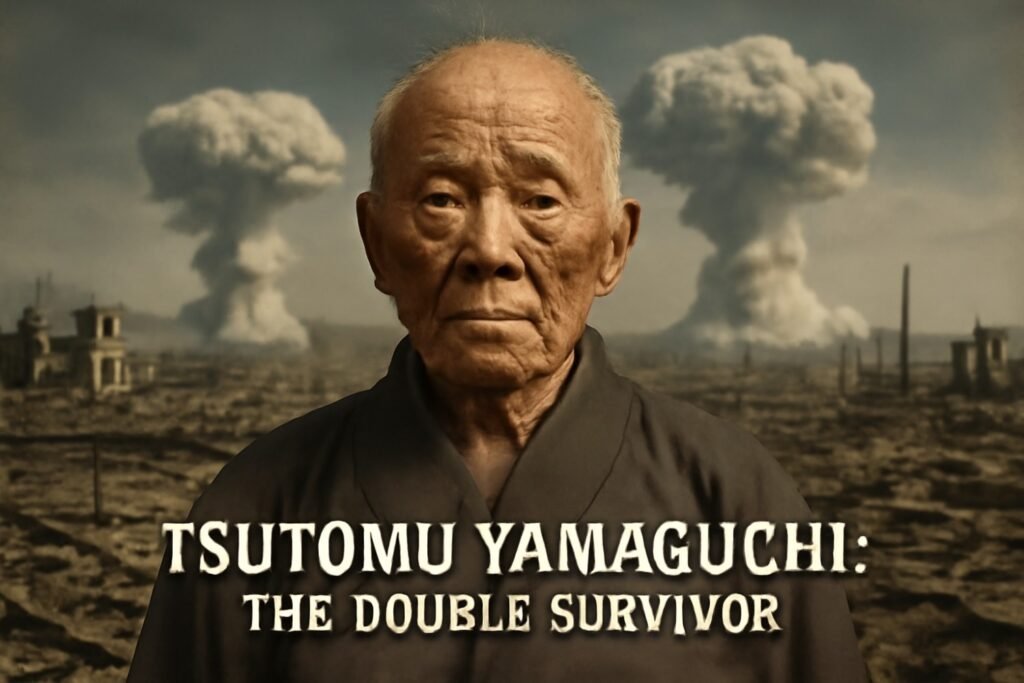
This was the life of Tsutomu Yamaguchi, the only officially recognized man to survive both atomic bombings Hiroshima and Nagasaki in August 1945.
“I can’t understand why the world cannot understand the agony of the atomic bomb victims.” – Tsutomu Yamaguchi, testimony to the United Nations, 2006
Setting the Stage: Japan in August 1945
A Country Under Siege
By the summer of 1945, Japan was already reeling. Cities lay in ashes from relentless firebombings. Food was scarce, fuel was rationed, and whispers of an “ultimate weapon” floated through the air.
Why Yamaguchi Was in Hiroshima
- Job Assignment: Yamaguchi, a 29-year-old engineer with Mitsubishi Heavy Industries, was in Hiroshima wrapping up a three-month assignment designing a new oil tanker.
- Departure Date: Fate had already marked his calendar. His departure date was August 6, 1945, the very morning Hiroshima became the first target of an atomic bomb.
08:15, 6 August 1945 Hiroshima’s Flash
The Detonation
The U.S. bomber Enola Gay dropped Little Boy, a uranium bomb that detonated 600 meters above the city, its force equal to 15,000 tons of TNT.
Yamaguchi’s Position
- Yamaguchi, just 3 km from ground zero, was on his way to the shipyard after forgetting his personal seal (a stamp required for paperwork). That small delay likely saved his life.
Injuries
- Both eardrums ruptured
- Temporarily blinded
- Left side of his body covered in burns
Callout: The flash was so intense that his high-school photograph later showed the exact moment his skin was seared through his shirt pattern, a detail he referenced in later speeches.
Immediate Aftermath
Through streets reduced to rubble and filled with screams, Yamaguchi found an air-raid shelter. He spent the night surrounded by the wounded and dying, bandaged in rags, before deciding to make the impossible journey home.
The Train Ride Through a Broken Country
How Trains Were Still Running
On August 7, still dizzy from blood loss, he limped to Hiroshima Station. Amazingly, trains were still running. Windows were shattered, platforms bent, but there was a route to Nagasaki.
The Journey
- 7 August: Yamaguchi and colleagues reached Hiroshima Station. Windows were shattered; platform roofs sagged, but a train was scheduled to Nagasaki via Hiroshima–Yamaguchi–Fukuoka.
- Medical State: Dizzy from blood loss and infection, he carried a raw sweet potato a gift from a farmer who pitied his condition.
Remarkably, the ride gave him five hours to absorb what he had witnessed unaware that history would repeat itself.
11:02, 9 August 1945 Nagasaki’s Fireball
Back to Work
Bandaged and feverish, Yamaguchi still reported to Mitsubishi’s Nagasaki office to explain why the Hiroshima project was delayed. His boss dismissed the Hiroshima bombing as “impossible.” Minutes later, Fat Man detonated over the Urakami Valley.
Second Survival
- Once again, Yamaguchi was about 3 km from the epicenter this time inside a reinforced stairwell. The thick concrete saved him from flying debris, but the blast aggravated his burns and radiation sickness.
“As I screamed ‘Lie down!’ the world turned white again,” he recalled. “I thought, ‘Is the mushroom cloud chasing me?’”
Immediate and Long-term Aftermath
Acute Radiation Syndrome
- Within days, Yamaguchi’s hair fell out. He suffered high fevers, vomiting, and exhaustion. His infant son became ill from radiation exposure but survived.
Family Losses
- Many relatives and colleagues were killed. The two co-workers who traveled with him from Hiroshima died in the Nagasaki blast.
Recognition as a “Nijū Hibakusha”
- For decades, Yamaguchi lived quietly, raising three children and writing poetry. Only in 2009, at age 93, did the Japanese government officially recognize him as a Nijū Hibakusha (“double bomb-affected person”).
Life After Two Atomic Bombs
Professional Path
- Returned to Mitsubishi in 1946, focusing on tankers again.
- Forced to limit exposure to chemicals due to lingering lung damage.
Family and Personal Growth
- Fathered two daughters and his son.
- Wrote poems about impermanence and hope.
Voice for Disarmament
- Traveled to New York in 2006 to speak at the United Nations.
- Published a memoir, “Ikasarete iru inochi” (“My Life, A Borrowed Life”), framing survival as a moral obligation.
Callout: “Survival isn’t luck alone it’s a responsibility,” Yamaguchi repeated in schools across Japan.
Lessons Eighty Years Later
The Fragility of Daily Life
We commute, we complain about delays, we plan weekend barbecues yet a single event can redraw an entire world in seconds.
The Long Shadow of Radiation
- Chronic illnesses among hibakusha still appear in medical journals (see study by Radiation Effects Research Foundation, 2020).
- Psychological trauma spans generations; grandchildren report anxiety about genetic damage.
Advocacy and Global Treaties
- The Treaty on the Prohibition of Nuclear Weapons (TPNW) entered into force in 2021.
- Survivors’ stories fueled momentum; Yamaguchi’s testimony is cited in campaign materials by ICAN (International Campaign to Abolish Nuclear Weapons).
A Personal Reflection
I first read Yamaguchi’s story on a humid summer night, the hum of a ceiling fan mirroring the droning B-29s he described. It shifted my casual interest in history into something visceral. Would I have boarded that train? Could any of us find courage to keep moving through smoke-filled stations, skin peeling, believing family still waited?
Those aren’t abstract questions, they’re daily reminders that resilience is an action, not a trait.
Final Takeaway
Tsutomu Yamaguchi’s life defies superlatives. He was not a superhero but an ordinary engineer who became an accidental witness to humanity’s entrance into the nuclear age twice. His survival emerged from small decisions: choosing a side street, dropping to the floor, boarding a train. Eighty years on, his message is disarmingly simple: remember, and prevent repetition.
Takeaway: Read the testimonies, share them, and add your voice whether writing to policymakers or simply teaching the next generation what “hibakusha” means. Memory, after all, may be the most reliable shield we have left.