
Introduction
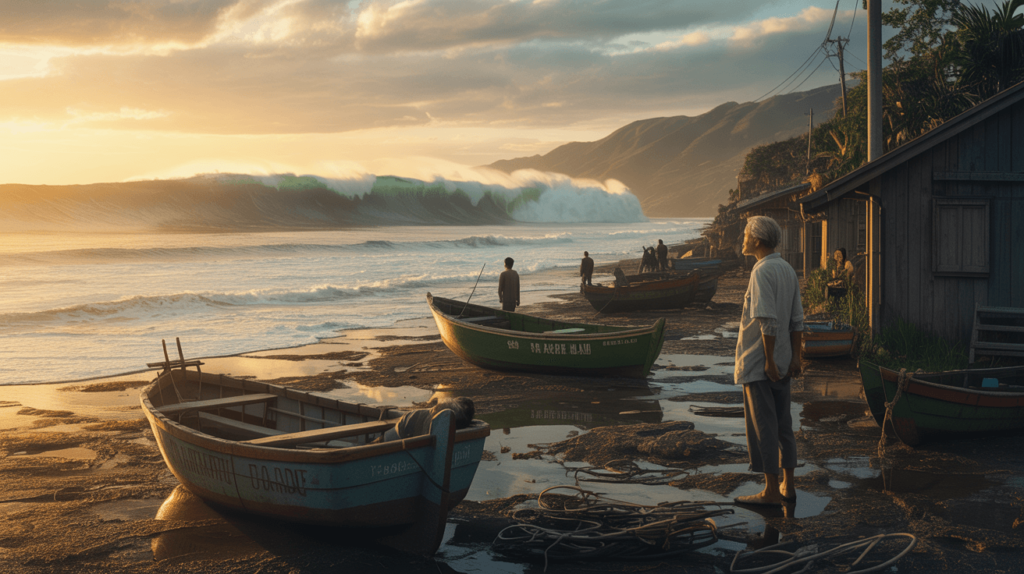
“Water remembers.” I first heard that phrase from a fisherman in Banda Aceh, Indonesia, eleven months after the 2004 Indian Ocean tsunami. He had lost his boat, yet every dawn he still walked to the shore, scanning the horizon for signs the sea was about to change its mind again. His daily ritual reminds me that tsunamis are not just rare news headlines; they leave long memories in coastal communities.
Every 5 November, the United Nations invites the world to pause for World Tsunami Awareness Day (WTAD). The date is more than a calendar note. It is a rallying point to
- understand how tsunamis occur,
- strengthen early-warning systems,
- share life-saving stories, and
- inspire local action that can make the next wave less deadly.
In the sections below we will explore the science, the history behind the observance, real-world progress, and practical steps you and your community can take whether you live by the ocean or hundreds of kilometres inland.
1. What Exactly Is a Tsunami?
Tsunami (from the Japanese words “tsu” = harbour and “nami” = wave) refers to a series of long-wavelength sea waves generated mainly by under-sea earthquakes, but also by volcanic activity, landslides, or even meteorite impacts.
1.1 The Science in Plain English
- A sudden shift in the sea floor displaces a huge volume of water.
- Energy travels outward at jet-liner speeds (up to 800 km/h in deep water).
- In the open ocean the wave height may be less than a metre, so ships barely notice.
- Near shore, the wave slows, bunches up, and can tower 10–30 metres or more.
1.2 A Global Hazard Map
According to UNESCO’s Intergovernmental Oceanographic Commission, at least 21 of the 50 world’s largest cities lie in tsunami-risk zones. The Pacific “Ring of Fire” is especially active, but recent events in the Mediterranean (2003 Algeria quake) and Indian Ocean (2004) remind us that no ocean basin is immune.
“If you can hear the ocean, you are in the tsunami zone.” Common saying in coastal emergency drills
2. Why 5 November? The Story of the Burning Rice Sheaves
World Tsunami Awareness Day is rooted in a 19th-century Japanese legend. On 5 November 1854, after feeling a quake, a village leader named Hamaguchi Goryō noticed the sea receding. To warn neighbours of the impending wave, he set fire to his valuable rice stacks on a hill. Villagers rushed uphill to help, narrowly escaping the tsunami. The episode, known as Inamura-no-hi (“The Fire of the Rice Sheaves”), became a classic story of risk awareness and selfless action.
When Japan proposed a global awareness day in 2015, the UN General Assembly embraced the idea. The date honours one person’s quick thinking and underscores how local knowledge can save lives an ethos baked into the Sendai Framework for Disaster Risk Reduction (2015-2030).
3. How Countries Mark WTAD
Every year carries a specific theme aligned with the Sendai Framework’s “7 Targets in 7 Years” campaign (2016-2022) and, after 2023, the “Early Warning for All” initiative.
3.1 Examples from Recent Years
- 2020 – Protecting Critical InfrastructureChile conducted a live drill at the Port of Valparaíso, testing backup power for harbour cranes.
- 2021 – Boosting International CooperationSmall Island Developing States (SIDS) partnered with Norway to obtain free access to high-resolution bathymetric data.
- 2022 – Early Warning SystemsIndia’s Odisha state launched a multilingual mobile-alert platform covering 460 km of coastline.
Callout: In 2023, UNESCO announced a goal to ensure every coastal resident is covered by tsunami early-warning services by 2030.
3.2 Common Activities
- Beach evacuation drills
- School art competitions on “Know Your Wave” themes
- Updated signage for tsunami evacuation routes
- Webinars linking scientists and local officials
- Social-media challenges such as #TsunamiReady
(For ideas, the UN Office for Disaster Risk Reduction posts a yearly toolkit with free graphics and lesson plans.)
4. Early-Warning Systems: The Backbone of Preparedness
4.1 Technological Layers
- Seismic Networks – Detect earthquakes within minutes.
- Sea-Level Gauges – Confirm whether a tsunami has formed.
- Deep-Ocean Assessment and Reporting of Tsunamis (DART) Buoys – Provide open-ocean data.
- Modelling Centres – Forecast wave arrival times and heights.
- Communication Channels – Sirens, SMS, radio, and increasingly, cell-broadcast alerts.
4.2 Room for Improvement
A 2022 study in Nature Communications estimated that 27 % of coastal communities still lack real-time access to tsunami warnings. Gaps are largest around parts of Africa and the Caribbean. Cost, maintenance, and data-sharing policies are hurdles WTAD seeks to spotlight.
5. Building Resilient Communities
5.1 Land-Use Planning
- Keep schools and hospitals outside inundation zones.
- Design “vertical evacuation” structures for flat, densely settled areas (e.g., Japan’s tsunami towers).
5.2 Education and Drills
A NOAA survey after the 2011 Tōhoku tsunami showed that 83 % of U.S. West Coast residents who evacuated did so because they remembered a past drill or educational programme. Practice converts theory into reflex.
5.3 Nature as a Buffer
Mangrove belts in Sri Lanka reduced 2004 tsunami mortality by up to 8 %, according to the IUCN. Replanting coastal vegetation can be a dual win for biodiversity and safety.
6. What You Can Do Even If You Live Inland
- Learn the Natural Signs
- Strong or long earthquake → move inland/uphill.
- Sudden sea drawdown → immediate danger.
- Know Your Local Alert Channels
- Opt into SMS services; follow your meteorological agency on social media.
- Pack a “Grab-and-Go” Bag
- Water, first-aid kit, flashlight, crucial documents.
- Share Stories
- Interview elders or neighbours about past coastal hazards; oral history keeps risk memory alive.
- Volunteer on WTAD
- Offer to help schools run a drill; post educational infographics; or donate to early-warning projects.
Personal note: After volunteering in Aceh in 2005, I now keep a laminated card in my wallet that says, “If the ground shakes, go uphill and stay there.” Most of my friends inland shrug, yet when they visit the coast, they ask for copies.
Conclusion: Turning Awareness into Habit
World Tsunami Awareness Day is not just a date for scientists or coastal officials. It is a reminder that a few minutes of preparation can decide who makes it home after the water recedes.
On 5 November, consider one concrete action: join a drill, update your emergency contacts, or simply share the legend of the burning rice sheaves with someone younger. Collective memory backed by modern science remains our most reliable life-vest.
If you’d like more practical tips, check our earlier post on “Building a 72-Hour Emergency Kit for Any Disaster.” Feel free to leave questions or your own preparedness stories in the comments below. Let’s keep the conversation flowing long after the tide goes out.