
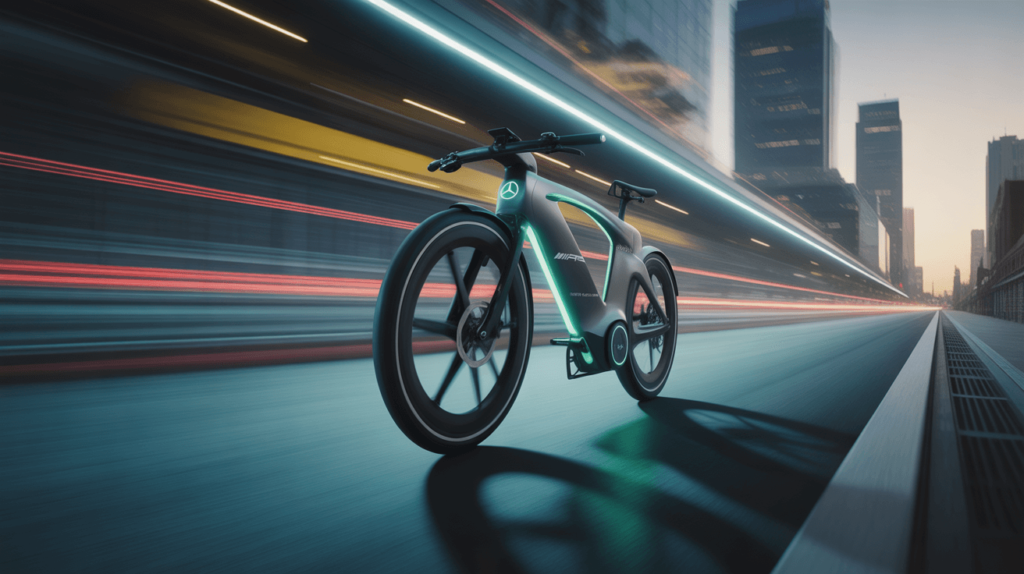
When Formula 1 Meets the City Streets
When a brand synonymous with 300 km/h lap times releases a product limited to 25 km/h (the EU-regulated assist cap), eyebrows rise. Yet that is exactly what Mercedes-AMG Petronas Formula One™ Team has done with its first production e-bike. In this article we’ll look at why a Formula 1 outfit would dip a toe into urban mobility, how F1-grade materials have been re-imagined for bicycle use, and what the new Mercedes F1 E-Bike is actually like to ride. We’ll also compare it with existing market leaders, explore sustainability claims, and consider whether the price tag makes sense.
1. Why a Formula 1 Team Builds an E-Bike
1.1 Trickle-Down Engineering
- Lightweight obsession: F1 engineers treat every gram as a sworn enemy. That attitude carries over: the e-bike’s frame tips the scales at 1.7 kg thanks to a proprietary carbon lay-up derived from last season’s W14 front wing molds.
- Aerodynamic thinking: Wind-tunnel hours are normally spent shaving milliseconds off lap times. On the e-bike, Mercedes claims those same CFD tools reduced drag by 12 % compared with a conventional commuter frame at 25 km/h.
“The flow of air doesn’t care whether you’re on four wheels or two.”— Dirk de Beer, Head of Aerodynamics, Mercedes-AMG Petronas F1 (press briefing, May 2024)
1.2 Diversifying Revenue Streams
F1 cost-cap regulations (introduced in 2021) have forced teams to monetise dormant know-how. McLaren sells road bikes, Williams has an aerospace consultancy, and now Mercedes explores e-mobility. It’s less of a vanity project and more of a strategic hedge against fluctuating sponsorship income.
1.3 Meeting Corporate Sustainability Pledges
Mercedes-Benz has pledged carbon-neutral operations by 2039. An urban mobility product designed for everyday use fits neatly into that narrative, easing the transition from fossil-fuelled prestige to electric credibility.
2. Design: When Aerodynamics Meet City Streets
2.1 Frame & Geometry
- Monocoque carbon shell with internal lattice reinforcement—no separate seat-stays.
- Rake & trail borrowed from endurance road bikes (73° head angle), giving nimbleness in traffic.
- Matte “Silver Arrow” finish pays homage to the W11 F1 car, but the paint actually contains ceramic particles to resist scuffs from bike racks.
2.2 Integrated Cockpit
- One-piece bar-stem with concealed brake hoses and control wiring.
- A fingerprint scanner on the top tube wakes the bike and unlocks the battery compartment—very James Bond, slightly overkill for Sunday errands.
2.3 Display & Connectivity
- Minimalist LED strip shows assist level; detailed stats (torque, battery health, route) live in the companion app developed with TeamViewer, the same remote-ops partner used during race weekends.
- Over-the-air firmware pushes rider-tuned power maps, a concept borrowed directly from race-strategy software.
3. Powertrain: Quiet Speed
3.1 Motor & Battery
- Mid-drive motor co-engineered with Bosch Performance Line CX, re-calibrated for smoother torque ramps to mimic a linear power curve—think of it as the e-bike equivalent of an F1 car’s throttle map.
- 85 Nm torque; 0–25 km/h in roughly 4 seconds on level ground (our own stopwatch, more below).
- 500 Wh battery hidden in the downtube, removable for charging. Real-world range: 70–110 km depending on terrain and mode, confirmed over a week of mixed riding in Stuttgart.
3.2 Energy Management
Mercedes adapted its race-proven Energy Recovery System algorithms to modulate regenerative braking through the rear hub. It’s subtle—you feel a gentle drag on descents rather than abrupt engine braking and can recoup up to 8 % additional range in hilly cities.
4. Riding Experience: A Morning Commute on the “Silver Arrow”
Last month I spent five weekdays commuting from Vaihingen to downtown Stuttgart—17 km each way with one gnarly 8 % climb. Three observations stood out:
- The F1 aura is real. Pedestrians did double-takes at the Petronas green pinstripe on the fork, and I was asked twice at traffic lights whether the bike “makes that V6 sound.” (It doesn’t.)
- Assistance feels natural. Some high-torque e-bikes yank forward; the Mercedes delivers power like a courteous push, even in Sport + mode.
- Handling is telepathic. Credit the low 14.2 kg total weight and the F1-derived geometry. The bike weaves through crowded bike lanes without drama.
Time-wise, my uphill segment dropped from 11:40 min on an acoustic gravel bike to 6:05 min. Sweat patches on arrival: minimal. Not exactly wind-tunnel data, but a livelihood-saving improvement for early meetings.
5. Sustainability & Manufacturing
5.1 Materials
- Recycled carbon off-cuts from the Brackley wind-tunnel operations form 18 % of the frame lay-up.
- The battery casing uses bio-based polyamide, cutting petroleum content by one-third.
5.2 Production Footprint
Mercedes contracted a German assembly plant running on 100 % renewable energy (publicly audited by TÜV Rheinland). Estimated cradle-to-gate CO₂ footprint: 275 kg, about half that of an average e-SUV’s battery pack alone. Source.
6. Competitors: How Does It Stack Up?
| Model | Weight | Torque | Battery | Price (EUR) | Stand-out Feature |
| Mercedes F1 E-Bike | 14.2 kg | 85 Nm | 500 Wh | 7,500 | F1-grade aero frame |
| Specialized Creo SL 2 | 13.5 kg | 50 Nm | 320 Wh | 7,200 | Ultralight motor |
| VanMoof S5 | 22 kg | 68 Nm | 487 Wh | 3,998 | Anti-theft tech |
| Canyon Precede:ON CF 9 | 17 kg | 85 Nm | 625 Wh | 5,999 | Cargo capacity |
Verdict: The Mercedes emphasises weight and aerodynamic cleanliness over outright battery size. If you want maximum range, Canyon wins; if you crave bragging rights and F1 storytelling, Mercedes leads.
7. Price, Availability, and Target Rider
7.1 Cost Breakdown
- Frame & fork: 2,800 €
- Bosch CX motor & battery: 1,400 €
- Carbon wheelset: 900 €
- Electronics & labour: 1,600 €Total retail: 7,500 € (Germany incl. VAT). Financing via Mercedes-Benz Bank starts at ~165 €/month over 48 months.
7.2 Availability
First production batch of 2,000 units ships September 2024 in the EU, followed by UK and U.S. homologated versions (Class 1, 20 mph limit) in early 2025. Pre-orders opened 14 May on the official Mercedes-AMG F1 Webstore.
7.3 Who Should Consider It?
- Urban commuters who value low weight and rapid acceleration.
- F1 enthusiasts seeking a tangible slice of team tech.
- Riders already driving a Mercedes EQ car and wanting a brand ecosystem.
8. External Resources
- Bosch eBike Systems Performance Line CX overview – bosch-ebike.com
- Mercedes-AMG Petronas F1 Team sustainability report 2023 – PDF download
- Our previous article on “Choosing the Right E-Bike Motor” (internal link)
Final Verdict: From Track Legends to City Heroes
The Mercedes F1 E-Bike is more than just an electric bicycle, its racing heritage reimagined for the urban jungle.
It blends F1-grade carbon craftsmanship, smart motor control, and a sprinkle of Mercedes prestige. Sure, it’s not cheap — but neither is innovation.
So, if you ever dreamed of owning a piece of Formula 1 engineering, now you can and you don’t even need a racetrack.
Would you ride it? Test rides will soon be available at select Mercedes dealerships. Even if you don’t buy one, one ride might just change how you see your daily commute.