
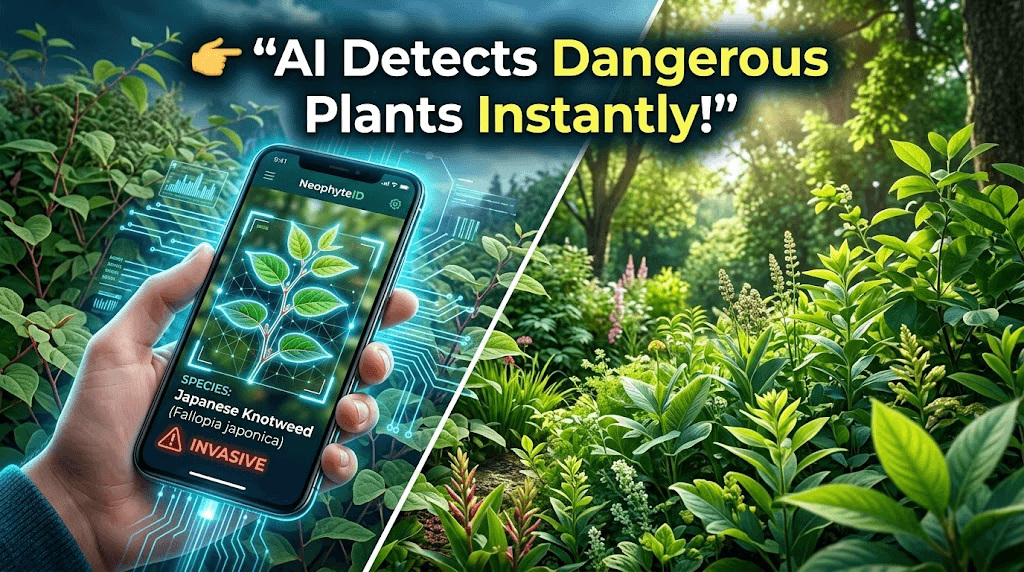
Imagine volunteering for a forest cleanup drive in the lush, green Western Ghats. Your mission? Uproot aggressive weeds choking the local flora. But in the thick of the jungle, a well-meaning volunteer accidentally rips out a rare, native plant, mistaking it for an invasive weed.
This isn’t a hypothetical scenario. It actually happened during a plant removal campaign at the Sughandagiri Tribal Eco Village in Wayanad, Kerala. And it sparked a groundbreaking idea that has now become a reality: NeophyteID.
Recently unveiled at the Kerala Science Congress, NeophyteID is an Artificial Intelligence (AI)-powered mobile application designed to detect, track, and manage invasive plant species. But it’s more than just a tech novelty it is a vital tool bridging the gap between cutting-edge AI and grassroots biodiversity conservation.
Here is a deep dive into why this app is making waves in the ecological community and how it serves as a blueprint for the future of environmental protection.
The Silent Threat of “Neophytes”
When we hear the word “invasion,” we rarely picture a leafy green vine. But invasive alien plant species often called neophytes are one of the greatest threats to global biodiversity. They grow aggressively, outcompete native plants for sunlight and soil nutrients, and can eventually collapse local ecosystems.
In biodiversity hotspots like the Western Ghats, the stakes couldn’t be higher. Up until recently, accurately identifying these ecological hitchhikers required a trained botanist. If a local resident or a student wanted to help clear out weeds, the risk of misidentifying and destroying native flora was simply too high.
Enter NeophyteID: Your Pocket Botanist
Developed by researchers at the Malabar Botanical Garden and Institute for Plant Sciences (MBGIPS), NeophyteID puts expert-level botanical knowledge directly into your smartphone.
Here is what makes the app so incredibly effective:
- Powered by Cutting-Edge AI: Under the hood, NeophyteID runs on the highly advanced YOLOv11 machine learning model. You simply snap a picture of a plant, and the AI instantly cross-references it with its database (currently trained on nearly 98 invasive species) to give you a highly accurate identification.
- Geospatial Tracking: It doesn’t just tell you what the plant is; it records where it is. Every verified identification is geotagged and fed into a live, interactive heatmap. This allows conservation planners and researchers to track the real-time distribution and spread of invasive species across the state.
- Built for the People: Available in both English and Malayalam, the app breaks down language barriers. It transforms everyday citizens, students, and local tribal communities into active “citizen scientists.”
Why This is a Game-Changer for Conservation
As someone who geeks out over the intersection of technology and nature, I find this application fascinating. We often talk about AI in the context of generating emails, coding, or creating digital art. But NeophyteID is a masterclass in using AI to solve tangible, real-world problems.
The brilliance of NeophyteID lies in its community-first approach. By crowdsourcing data collection, the app scales environmental monitoring in a way that underfunded ecological departments simply cannot do on their own.
When everyday people are empowered to safely identify and manage invasive species in their own backyards, local parks, or community forests, the impact is exponential.
Final Thoughts: Technology with a Purpose
NeophyteID is a testament to what happens when we design technology to serve the planet. Spearheaded by developers like N. Alim Yusuf and scientists at MBGIPS, it turns every smartphone into a shield for our native ecosystems.
As AI continues to evolve, I hope we see more tools like this globally applications that don’t just keep us scrolling, but actually encourage us to step outside, observe our environment, and protect it.