
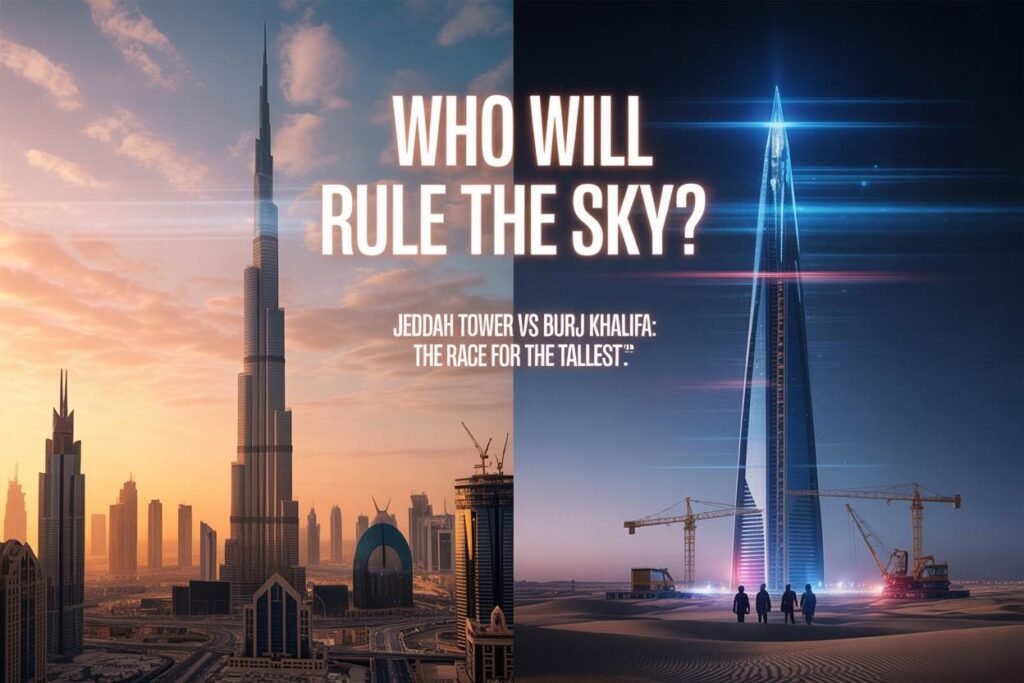
Introduction: A New Giant Rises in the Desert
It starts with a window seat on a flight into Dubai. The sun dips low, and there it is the Burj Khalifa, piercing the clouds like a steel needle stitched into the heavens. For over a decade, it held the crown as the tallest building in the world, an architectural marvel, a global icon, and a powerful statement by the UAE to the world.
But what if that reign is nearing its end?
Just 1,600 kilometers away, in Saudi Arabia, a new titan is rising. After years of delay, Jeddah Tower (also known as the Kingdom Tower) is back on track and it’s coming for the crown.
The Burj Khalifa: More Than Just a Tall Building
A Decade of Dominance
When the Burj Khalifa officially opened in January 2010, it didn’t just break records it smashed them. Towering 2,717 feet (828 meters) above Dubai, its silhouette became an instant global icon.
- Height: 2,717 ft (828 m)
- Floors: 163 (plus extra mechanical floors)
- Cost to Build: Estimated at $1.5 billion
- Year Complete: 2010
“For years, the Burj Khalifa has been more than a landmark it’s been a badge of Dubai’s transformation and audacity.”
I remember my own first visit: craning my neck upward, marveling at the scale, and wondering how it altered the lives of those beneath its shadow. For millions, it’s a symbol of aspiration, proof that the improbable can become everyday reality.
A Catalyst for Regional Ambition
The Burj Khalifa’s success did more than put Dubai on the map it became a catalyst, sparking a new era of supertall towers throughout the Middle East and beyond.
Jeddah Tower: Saudi Arabia’s Bid for Global Greatness
From Vision to Reality (and a Few Hiccups)
Jeddah Tower, originally known as the Kingdom Tower, was announced in 2011 with a clear mission: to build the world’s first kilometer-high (3,281 ft or 1,000 meters) skyscraper. Construction began in 2013 but faced numerous challenges, financial hurdles, labor disputes, and regional instability stalled progress for years. In 2023, however, news surfaced that the project had reignited, with a new completion target of 2028.
What Sets Jeddah Tower Apart?
- Projected Height: 3,281 ft (1,000 m)
- Planned Floors: 167+
- Estimated Cost: $1.2 – $1.5 billion (surprisingly, potentially less than Burj Khalifa)
- Key Features:
- The world’s highest observation deck
- A luxury hotel, apartments, office spaces, and retail areas
“Jeddah Tower aims to redefine not just architecture but a nation’s place on the world stage.”
An Architectural Feat
One fascinating aspect is the slender, elegant design. According to architect Adrian Smith, who also designed the Burj Khalifa, Jeddah Tower’s tapered, streamlined structure will help it withstand extreme wind loads at such daunting heights.
The Race Is More Than Just Height: What’s Really at Stake?
1. National Ambition and Identity
These skyscrapers are less about office space and more about symbolism. For Dubai and Saudi Arabia, record-setting architecture is a statement a way to declare, “We’re global players we set the pace.”
2. Economic Transformation
Both cities are leveraging these towers as cornerstones for broader transformation:
- Dubai: Used the Burj Khalifa to pivot toward tourism, luxury, and real estate.
- Jeddah (and Saudi Arabia): Envisions Jeddah Tower as the centerpiece of a new urban district, helping diversify the economy beyond oil.
3. Engineering and Sustainability Challenges
Building this high brings unique hurdles:
- Water pressure at unprecedented heights
- Wind resistance and seismic concerns
- Elevator technology (multi-stage elevator systems now being pioneered)
Example: How to Pump Concrete Nearly a Kilometer High
During the Burj Khalifa’s construction, engineers set a world record for pumping concrete more than 2,000 feet straight up. Jeddah Tower will push those limits even further, requiring new methods and perhaps setting new global benchmarks.
The Broader Middle Eastern Skyline Revolution
More Than Two Towers
The Middle East’s appetite for sky-high architectural feats is hardly limited to Dubai and Jeddah. Projects like:
- Abraj Al Bait (Mecca, Saudi Arabia): Host to one of the world’s largest clock faces
- ADNOC Headquarters (Abu Dhabi): Blending sustainability with innovation
- Dubai Creek Tower: Once hyped to surpass Burj Khalifa but recently paused
It’s as if the entire region is building not just cities but global statements, forging a brand recognized for ambition, ingenuity, and, yes, friendly rivalry.
Why Do We Keep Building Higher?
A Human Drive to Reach for the Sky
There’s a reason people flock to viewing decks and crane their necks upward it stirs something universal. These architectural marvels speak to a deeply felt urge to exceed limits, to mark our place in history.
“Every supertall tower is a monument not just to engineering, but to imagination.”
What Will Jeddah Tower Mean for the Region?
That’s the big question. Will it spark a new era of economic opportunity, global investment, or simply stand as a breathtaking symbol? Only time will tell, but the anticipation is already reshaping expectations for what’s possible across the Middle East.
Conclusion: The Sky’s No Longer the Limit
As Jeddah Tower rises from the deserts of Saudi Arabia, poised to outdo the Burj Khalifa, we’re witnessing more than an architectural rivalry. We’re seeing entire nations use skyscrapers to write new narratives about innovation, ambition, and cultural pride.
Whether you’re a casual observer, architecture buff, or traveler dreaming of visiting the next tallest, these structures invite us to ask: What boundaries are left to break? And how will the next leap upward change the way the world sees the Middle East and itself?
What are your thoughts? Would you visit Jeddah Tower when it opens?
Feel free to leave your comments, and if you want to dive deeper, check out more about breathtaking architecture or the evolution of ultra-tall structures.
“In the Middle East, they’re not just building skylines. They’re building statements.”