
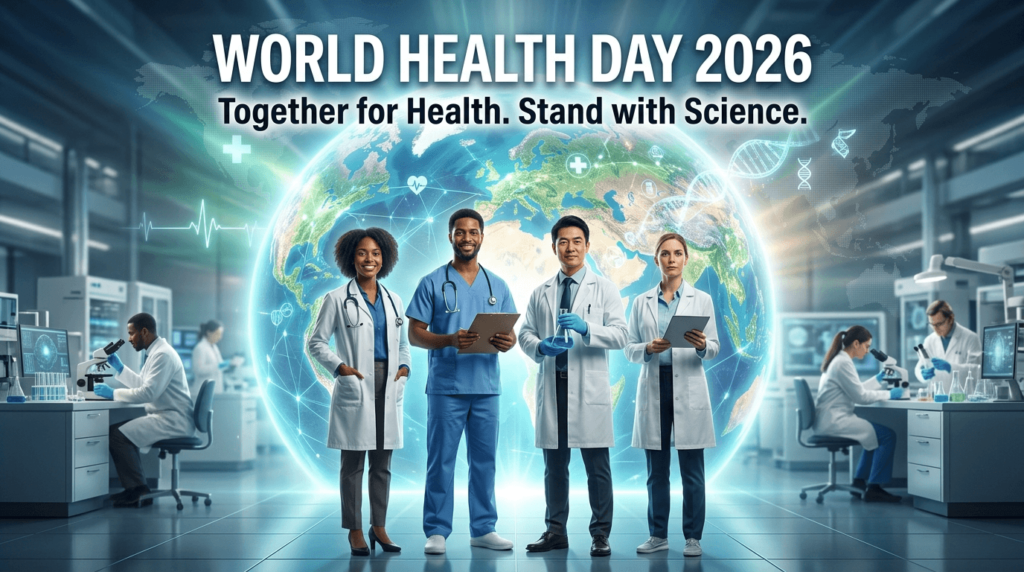
We often take our health for granted until the very moment it is threatened. It is a quiet background hum in our daily lives, right up until a fever breaks, a test result comes back, or a global crisis shifts our entire reality. If recent history has taught humanity anything, it is that health is not just a personal matter it is a shared, global vulnerability.
When one corner of the world sneezes, the rest of the globe inevitably reaches for a tissue.
This deep, undeniable connection is exactly why the United Nations and the World Health Organization (WHO) observe World Health Day every year on April 7. But the 2026 observance brings a sharper, more urgent focus to the forefront. It asks us to look past borders, politics, and opinions, and instead look through the lens of empirical truth.
What is World Health Day and Why It Matters Today
World Health Day is much more than a symbolic date on the international calendar. It is an annual global pulse-check. Spearheaded by the UN to promote global health awareness, this day forces governments, communities, and individuals to pause and evaluate the state of our collective well-being.
Today, this day matters more than ever because our challenges have evolved. We are no longer just fighting localized outbreaks; we are battling the health impacts of climate change, rising antimicrobial resistance, and an epidemic of misinformation. World Health Day serves as an anchor, reminding us that health equity is a fundamental human right, not a privilege reserved for a lucky few.
Decoding the 2026 Theme: “Together for Health. Stand with Science”
Every year, World Health Day adopts a specific theme to highlight a pressing global issue. The 2026 theme is both a rallying cry and a profound statement: “Together for Health. Stand with Science.”
Why this theme, and why now? We live in an era where information travels faster than the speed of sound, but unfortunately, so does fiction. In recent years, public trust in scientific institutions has faced unprecedented challenges. This theme serves as a powerful reminder that our greatest victories over disease from the eradication of smallpox to the rapid development of life-saving vaccines were not born from guesswork. They were born from rigorous, peer-reviewed science.
Standing with science means rejecting the noise. It means funding research, trusting medical professionals, and understanding that the path to a healthier tomorrow is paved with data, trials, and relentless scientific curiosity.
The Role of Science and Global Collaboration in Health
Science is not a solitary pursuit; it is a global conversation. A breakthrough in a laboratory in Tokyo can save a life in Toronto. When we say “Together for Health,” we are acknowledging that scientific collaboration is the ultimate weapon against global health crises.
No single nation can cure cancer, stop a pandemic, or reverse the health impacts of pollution on its own. It requires a borderless exchange of data, resources, and brilliant minds. When scientists collaborate, they don’t just share test tubes and statistics; they share a profound commitment to human survival.
A Look Back: The Roots of Global Health
To truly appreciate the gravity of World Health Day, we have to rewind the clock. Picture the world in 1948. The globe was still dusting itself off from the devastating rubble of the Second World War. Nations realized that to rebuild a fractured world, they needed to safeguard its people.
During the First World Health Assembly in 1948, the World Health Organization was officially born. To commemorate this monumental step forward, the assembly proposed an annual day of awareness. April 7 was chosen to forever mark the founding of the WHO.
The very first World Health Day was observed in 1950, and for over seven decades, it has stood as a beacon of international cooperation, highlighting everything from mental health awareness to the importance of nurses and midwives.
The Epicenter of 2026: International One Health Summit
While World Health Day is celebrated in communities worldwide, 2026 brings a massive, focused event to the global stage. From April 5 to April 7, 2026, global leaders, top-tier scientists, and policymakers will converge in Lyon, France for the International One Health Summit.
This summit perfectly encapsulates the 2026 theme. The “One Health” approach is a scientific framework that recognizes a simple but profound truth: human health is deeply interconnected with the health of animals and our shared environment.
You cannot have healthy humans on a sick planet. By hosting this summit, France is setting the stage for critical discussions on how ecological preservation, veterinary science, and human medicine must work hand-in-hand to prevent the next great health crisis.
Why This Day is More Important Now Than Ever Before
We are standing at a critical crossroads. The decisions we make regarding global health policies today will echo for generations. Climate change is altering the map of infectious diseases, pushing them into new territories. Urbanization is crowding populations, and our food systems are under immense strain.
In this complex web of modern challenges, ignoring science is a luxury we simply cannot afford. World Health Day 2026 is a necessary wake-up call. It is a demand for health literacy, a plea for adequate medical funding, and a celebration of the researchers who spend their lives looking through microscopes so the rest of us can live longer, healthier lives.
Final Thoughts: A Call to Action
“Together for Health. Stand with Science” is not just a theme for policymakers in Geneva or scientists in Lyon. It is a mandate for all of us.
It means making informed choices about our own health based on medical consensus rather than internet rumors. It means supporting policies that protect our environment, knowing that clean air is just as vital as any medicine.
As we approach April 7, 2026, let us remember that global health is a shared inheritance. We must protect it fiercely, nurture it collaboratively, and always, without hesitation, let science light the way forward.