
Remember that feeling back in 2023 when AI first really exploded onto the scene? It felt like magic. Suddenly, we had these digital assistants that could write poems, answer trivia, and help us draft emails.
Fast forward to 2026. The magic is still there, but it’s grown up. It’s no longer just a cool party trick; it’s the engine powering our daily work, our studies, and our businesses. If you aren’t using an AI tool today, you’re essentially choosing to walk while everyone else is taking the bullet train.
But here’s the problem: the market is flooded.
Every week, there’s a new “game-changing” AI chatbot claiming to be the ultimate solution. Trying to figure out which one is actually worth your time and your money can feel like navigating a maze blindfolded. Should you stick with the classic ChatGPT? Is Google Gemini finally the smarter choice? Or is Perplexity AI the new king of research?
I’ve spent the last few months deeply testing the big players not just asking them to write silly jokes, but pushing them hard on coding, deep research, SEO content writing, and everyday productivity tasks.
If you are a blogger, student, freelancer, or just an AI beginner trying to make sense of it all, this guide is for you. Let’s break down the best AI tools of 2026 and find the perfect fit for your specific needs.
Why You Can’t Ignore AI Tools Anymore
Let’s be honest: the novelty of asking a chatbot to write a song about your cat wore off a long time ago. Today, AI is about leverage.
Think about the tasks that drain your energy. For a digital marketer, it might be outlining a month’s worth of social media posts. For a student, it’s combing through dense academic papers. For a business owner, it’s drafting endless emails or analyzing customer feedback.
AI tools act as your tireless intern. They handle the heavy lifting, the brainstorming, and the initial drafting, freeing you up to do what humans do best: strategize, inject emotion, and make final decisions.
In 2026, using the best AI chatbot isn’t about being lazy; it’s about being efficient. It’s the difference between staring at a blank page for an hour and having a solid rough draft ready to edit in ten seconds.
The Big AI Showdown: Detailed Comparisons
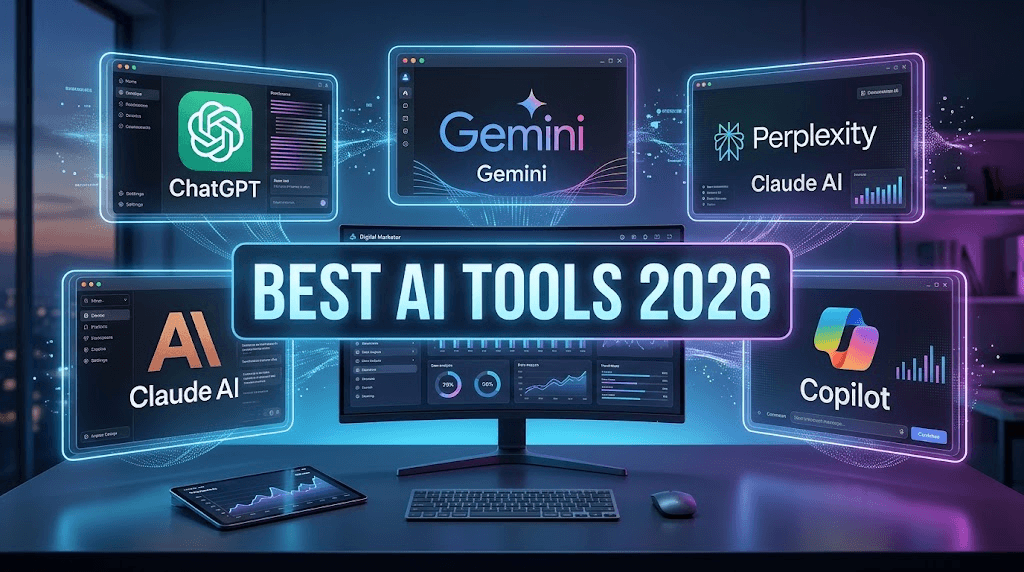
Let’s get into the weeds. We are going to look at the five major contenders dominating the AI landscape right now: ChatGPT, Perplexity, Google Gemini, Claude, and Microsoft Copilot.
1. ChatGPT (by OpenAI)
The Household Name and All-Rounder
If AI had a prom king, it would be ChatGPT. OpenAI essentially kicked off this revolution, and they’ve maintained a strong lead by constantly iterating. In 2026, ChatGPT (powered by their latest models) is a beast. It’s incredibly versatile, acting as a conversational partner, a coding assistant, and a creative brainstorming buddy.
It feels the most “human” in its conversational flow. You can give it a massive prompt, ask it to refine its answer three times, and it rarely loses the thread.
Key Features:
- Excellent conversational memory.
- Strong custom GPT builder (create your own specialized AI agents).
- Seamless integration with DALL-E for image generation.
- Advanced data analysis capabilities.
Pros:
- Incredibly versatile across almost all tasks.
- Huge community and ecosystem (tons of tutorials and shared custom GPTs).
- The mobile app is fantastic, especially the voice conversation feature.
Cons:
- Can still “hallucinate” (make things up) if you don’t prompt it carefully.
- Sometimes its writing style can feel a bit generic or “AI-ish” out of the box without strong prompting.
Pricing:
- Free tier available (with usage limits on the newest models).
- Plus tier usually around $20/month.
Best Use Case: Brainstorming, general content drafting, coding help, and creating custom AI agents for specific tasks.
2. Perplexity AI
The Ultimate Research Engine
If you are tired of sifting through Google search results filled with ads and SEO spam, Perplexity is going to blow your mind. It is not just a chatbot; it’s an “answer engine.”
Instead of just predicting the next word like ChatGPT, Perplexity actively searches the live web, reads multiple sources, synthesizes the information, and—crucially provides clickable footnote citations for every claim it makes.
Key Features:
- Real-time web browsing with deep synthesis.
- Strict citation formatting (it proves where it got the info).
- “Copilot” mode that asks you clarifying questions to narrow down the search.
- Organized “Collections” for organizing your research projects.
Pros:
- Unmatched for factual accuracy and current events.
- The citations build immense trust—you can verify everything.
- Excellent at cutting through SEO fluff to find the actual answer.
Cons:
- Not as good at creative writing or casual conversation as ChatGPT or Claude.
- UI can feel a bit cluttered compared to simpler chat interfaces.
Pricing:
- Free version available.
- Pro version usually around $20/month (gives access to more advanced search models).
Best Use Case: Deep research, fact-checking, academic studies, and finding accurate, up-to-date information quickly.
3. Google Gemini
The Ecosystem Powerhouse
Google’s answer to ChatGPT had a rocky start, but in 2026, Gemini is a serious heavyweight. What makes Gemini unique is its deep integration into the Google ecosystem that you probably already use: Docs, Gmail, Drive, and Android.
Gemini excels at reasoning and handling multiple types of media at once (multimodality). You can upload a video, a massive PDF, and an image, and ask it to analyze all three simultaneously.
Key Features:
- Native integration with Google Workspace.
- Incredible multimodal capabilities (understands text, image, audio, and video deeply).
- Massive context window (you can feed it entire books or massive codebases at once).
Pros:
- If you live in Google Docs and Gmail, the workflow is seamless.
- Lightning fast response times.
- Excellent at summarizing massive documents or long YouTube videos.
Cons:
- Sometimes leans toward being overly cautious or “preachy” in its responses.
- The difference between the free and paid versions can be confusing.
Pricing:
- Free version available.
- Gemini Advanced (part of Google One AI Premium) usually around $20/month.
Best Use Case: Summarizing massive documents, analyzing videos/images, and drafting content directly within Google Workspace.
4. Claude (by Anthropic)
The Writer’s Best Friend
If you care about how your content sounds, you need to try Claude. Developed by Anthropic (a company founded by former OpenAI researchers), Claude is widely considered to have the most natural, nuanced, and “human-sounding” writing style of all the major AI tools.
It’s less likely to use those annoying AI cliché words (like “delve,” “tapestry,” or “testament”). It’s also incredibly good at following complex, multi-step instructions without getting confused.
Key Features:
- Exceptional natural language generation.
- Very large context window.
- “Artifacts” feature (it can create a dedicated window for code, documents, or designs it generates, making editing easier).
- Strong focus on safety and reducing harmful outputs.
Pros:
- The best AI for content writing that doesn’t sound robotic.
- Excellent at editing and refining existing text.
- The “Artifacts” UI is a massive productivity booster for coding and document creation.
Cons:
- Doesn’t have real-time web browsing natively integrated in the same way Perplexity does.
- No native image generation.
Pricing:
- Free tier available.
- Claude Pro usually around $20/month.
Best Use Case: Long-form blog posts, copywriting, editing, and tasks requiring complex reasoning or strict adherence to a specific tone of voice.
5. Microsoft Copilot
The Enterprise Standard
Microsoft took the power of OpenAI’s models (they are major investors in OpenAI) and baked it directly into Bing, Windows, and Microsoft 365 (Word, Excel, PowerPoint).
Copilot is less of a standalone destination and more of a companion that follows you around your digital workspace.
Key Features:
- Integrated into the Edge browser and Windows OS.
- Deep integration with Microsoft Office apps.
- Free access to relatively recent OpenAI models and DALL-E image generation.
Pros:
- The free version is incredibly powerful, offering features you often pay for elsewhere.
- If you use Word or Excel heavily, it’s a game-changer for drafting and data analysis.
- Provides web sources for its answers (similar to Perplexity, though slightly less rigorous).
Cons:
- The interface can feel a bit clunky or overly commercialized sometimes.
- Can occasionally get confused between being a search engine and a creative assistant.
Pricing:
- Free via web/Edge browser.
- Copilot Pro (for Microsoft 365 integration) usually around $20/month.
Best Use Case: Free access to powerful AI models, image generation, and boosting productivity within Microsoft Office applications.
Quick Comparison Table
| Feature | ChatGPT | Perplexity | Google Gemini | Claude | Microsoft Copilot |
| Best For | Brainstorming & Versatility | Deep Research & Fact-Checking | Google Workspace Users & Huge Files | Natural Writing & Nuance | Free Access & MS Office Users |
| Writing Quality | Good (needs prompting) | Average (functional) | Good | Excellent (Most Human) | Good |
| Research/Web | Good | Exceptional | Very Good | Limited | Very Good |
| Integrations | Huge App Ecosystem | Standalone | Google Ecosystem | Standalone | Microsoft Ecosystem |
| UI/UX | Clean & Simple | Research-Focused | Clean | Excellent (Artifacts feature) | Slightly Cluttered |
Category Winners: Which AI Tool is Best For You?
Still not sure which one to pick? Let’s break it down by who you are and what you need to do.
Best AI for Students
🏆 Winner: Perplexity AI When you are writing an essay or a research paper, you cannot afford to have an AI hallucinate facts. Perplexity’s strict citation system means you can trace every single claim back to its original source. It’s incredible for literature reviews, understanding complex topics quickly, and finding credible sources for your bibliography.
Best AI for Blogging and Content Writing
🏆 Winner: Claude AI If you want to rank on Google and keep readers engaged, your writing cannot sound like a robot wrote it. Claude is the undisputed king of natural tone. It understands subtle instructions regarding voice, pacing, and formatting far better than ChatGPT. It’s the closest thing to having a senior human editor reviewing your drafts.
Runner-up: ChatGPT (if you use highly detailed custom prompts).
Best AI for SEO
🏆 Winner: ChatGPT (with custom GPTs) For SEO, you need versatility. You need to analyze keywords, cluster topics, write schema markup, and draft content. ChatGPT’s ability to create custom GPTs means you can build an “SEO Assistant” tailored exactly to your workflow. You can feed it your brand guidelines and your preferred keyword strategies, and it will execute them consistently.
Best AI for Research
🏆 Winner: Perplexity AI This isn’t even close. If your job involves finding the truth on the internet quickly—whether you are a journalist, an analyst, or just settling a debate Perplexity is the only tool you need.
Best Free AI Tool
🏆 Winner: Microsoft Copilot If you don’t want to spend $20 a month, Copilot is your best bet. Microsoft gives you access to very powerful, recent AI models and DALL-E image generation entirely for free through their Edge browser or the Copilot app.
Best AI for Coding
🏆 Winner: Claude AI (or ChatGPT) This is a tight race. ChatGPT has historically been the favorite for developers. However, Claude’s recent updates, combined with its “Artifacts” feature (which lets you see and interact with the code it generates in a side panel), have made it the go-to choice for many programmers in 2026.
Real-Life Examples: How to Actually Use These Tools
Don’t just use these tools as a glorified Google search. Here are practical ways to integrate them into your workflow:
- The Freelancer’s Proposal: Instead of starting from scratch, paste a client’s job description into Claude. Prompt it: “Act as an expert copywriter. Write a customized, persuasive proposal for this job. Focus on how my skills [insert your skills] solve their specific pain points mentioned in the description. Keep the tone professional but warm.”
- The Blogger’s Content Gap Analysis: Use Perplexity to search for a keyword you want to target. Prompt it: “Find the top 5 articles ranking for [keyword]. Analyze them and tell me what information is missing from all of them. What are the ‘content gaps’ I can fill in my own article to make it better?”
- The Student’s Lecture Summarizer: Record a confusing lecture (make sure you have permission!). Upload the audio file to Google Gemini. Prompt it: “Summarize this lecture into a study guide. Highlight the 5 most important concepts and create a 10-question multiple-choice quiz based on the material.”