
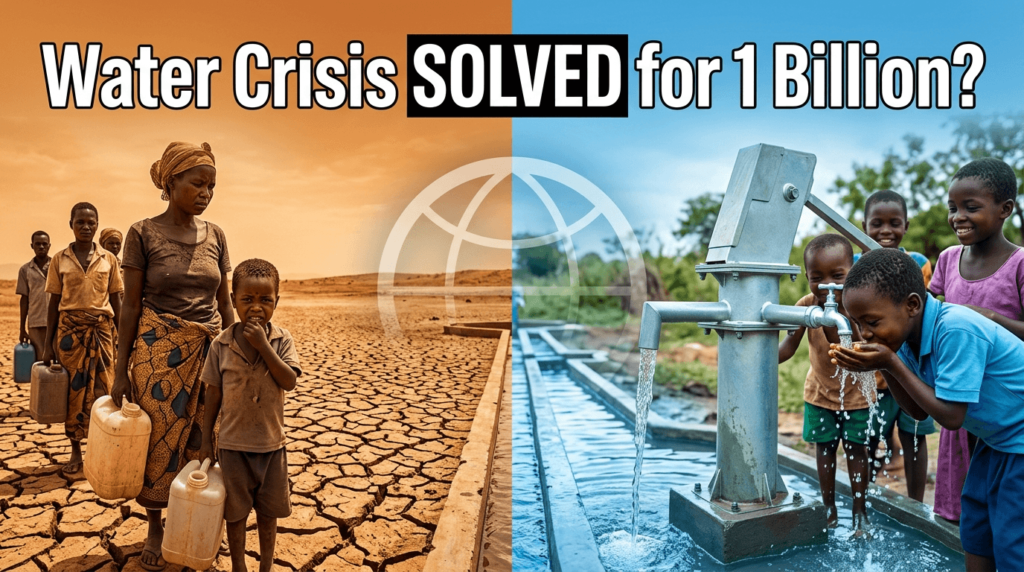
Let’s be honest for a second: when was the last time you turned on your tap and worried nothing would come out? For most of us in the developed world, water is an afterthought. But as we navigate 2026, the reality for half the planet is staggeringly different.
Right now, 4 billion people half of the global population face severe water scarcity for at least part of the year. It’s a quiet catastrophe that’s drying up rivers, shuttering farms, and stalling economies.
Enter the World Bank. At their recent Spring Meetings, they launched a massive, ambitious project called the Water Forward initiative. The headline goal? To deliver water security to 1 billion people by the year 2030.
But is this just another grand political promise destined to evaporate, or is it the actual blueprint we need to solve the global water crisis? Let’s dive into what this initiative really means, why it matters so much right now, and whether it can actually work.
What Exactly is the ‘Water Forward’ Initiative?
Historically, global attempts to fix water issues involved throwing money at physical projects building a dam here, a desalination plant there. But infrastructure without good policy is like buying a Ferrari when you don’t have a driver’s license. It just sits there and rusts.
The World Bank initiative takes a radically different approach. Unveiled in April 2026, Water Forward doesn’t just fund pipes and pumps. It focuses heavily on governance, policy reform, and making water systems financially sustainable.
The World Bank itself is committing to reach 400 million people with its own capital, while rallying a massive coalition of regional development banks, private investors, and philanthropies to reach the remaining 600 million.
The Power of “Water Compacts”
At the beating heart of Water Forward are country-led “Water Compacts.” Instead of the World Bank dictating terms, individual nations are stepping up to draft their own integrated national strategies.
Fourteen pioneer nations including Kenya, Senegal, Jordan, and Uzbekistan have already signed on. They are publicly committing to reforming their water sectors at the highest political levels to attract investment and build resilient water infrastructure.
Why Water Security Matters More Than Ever in 2026
You might be wondering: why the sudden urgency?
By 2030, global demand for freshwater is projected to outstrip supply by a terrifying 40%. Combine that with relentless population growth and the escalating impacts of climate change, and you have a recipe for disaster. We are seeing droughts devastate crops in Africa and extreme floods overwhelm outdated drainage systems in Asian megacities.
Building climate resilience isn’t just an environmental buzzword anymore; it’s an economic survival tactic.
Protecting 1.7 Billion Jobs
Here is the most eye-opening statistic you’ll read today: roughly 1.7 billion jobs worldwide depend entirely on water.
From agriculture and energy production to manufacturing and hospitality, water is the engine of the global economy. World Bank President Ajay Banga nailed it when he said, “When water systems work, farmers produce, businesses operate, and cities attract investment.”
If we don’t implement sustainable water management, we aren’t just losing drinking water—we are risking global economic collapse. With 1.2 billion young people entering the workforce in developing nations over the next decade, we simply cannot afford to let our water systems fail.
How Developing Countries Stand to Gain
So, what does this look like in the real world? How does a high-level banking initiative translate to actual clean water access for a farmer in the Global South?
Let’s look at Uzbekistan as a prime example. Heavily reliant on water for its agriculture, the country just signed a Water Compact with a clear, measurable goal: modernize 100% of its irrigated land with water-saving technologies and reduce water loss by 25%.
By digitalizing water management and bringing in efficient irrigation, farmers in Uzbekistan will be able to grow more crops with significantly less water. This means higher incomes for rural families, lower food prices for cities, and a stable economy that isn’t derailed by a single dry season.
This is the kind of targeted, local impact the initiative aims to replicate across Africa, the Middle East, and South Asia.
The Giant Elephant in the Room: Challenges and Criticisms
I’d love to tell you this initiative is a flawless silver bullet, but we have to look at the math. And the math is daunting.
Currently, annual water investments in developing countries hover around $164 billion. That sounds like a lot until you realize it’s a mere 0.5% of global GDP. To actually close the gap and secure water for everyone, we need an additional $131 to $140 billion every single year.
Where is that money coming from? The World Bank is heavily pushing for private sector investment, aiming to double private participation from its current 10%.
And here is where the criticism rolls in. Many human rights advocates get nervous when they hear “private sector” and “water” in the same sentence. There is a legitimate fear that pushing for financially sustainable utilities might lead to the privatization of water, driving up costs for the world’s poorest people.
The World Bank insists the goal isn’t privatization, but rather “private participation alongside public oversight.” Still, executing that delicate balance without leaving the most vulnerable behind will be the initiative’s biggest tightrope walk.
The Verdict: Can We Secure Water for a Billion People by 2030?
The Water Forward initiative is easily one of the most comprehensive, economically grounded plans we’ve seen to tackle the global water crisis. By shifting the focus from “charity projects” to “economic investments,” the World Bank is finally speaking a language that global markets understand.
Will it hit the 1-billion-person mark by 2030? It’s going to be an incredibly steep uphill battle. It requires developing nations to aggressively reform their policies, and it requires wealthy nations and private capital to actually put their money where their mouths are.
But for the first time in a long time, we have a unified, global strategy that treats water like the priceless, job-creating, life-sustaining resource it actually is. And honestly? We don’t have the luxury of letting it fail.
What are your thoughts on the Water Forward initiative? Do you think private investment is the key to solving the water crisis, or should water remain strictly in the hands of the public sector? Drop your thoughts in the comments below!