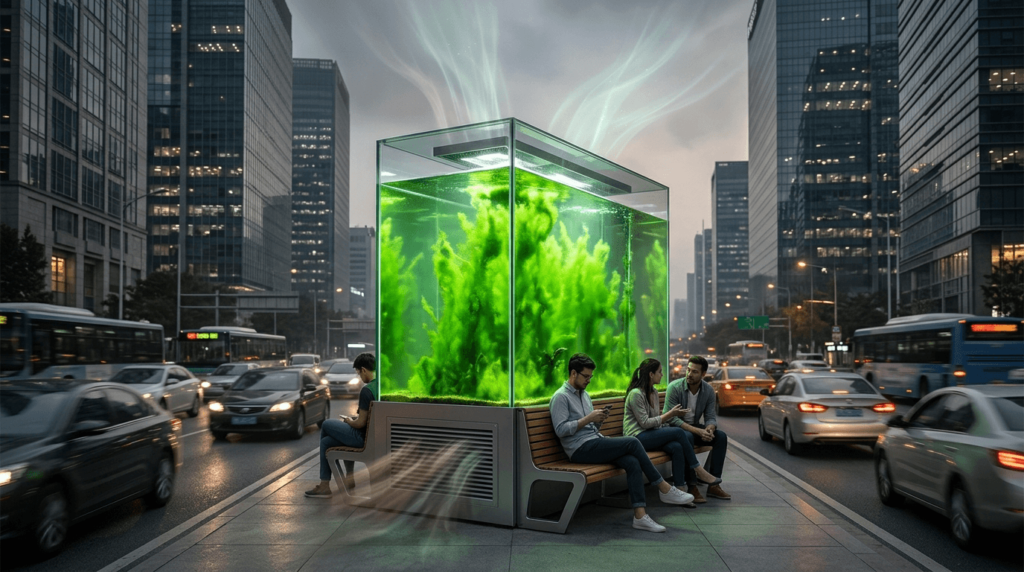
Imagine walking down a busy, smog-filled city street. Your chest feels tight, the air smells like exhaust, and there isn’t a single patch of dirt to plant a tree. Then, you see it: a glowing, neon-green tank of bubbling water doubling as a street bench.
It looks like a prop from a sci-fi movie, but it’s quietly doing the work of two mature trees.
Welcome to the reality of the “liquid tree.”
When photos of this futuristic green tank (officially called LIQUID3) first hit social media, the internet collectively freaked out. The comments rolled in: Are we giving up on nature? Are we replacing forests with algae aquariums? Is this the start of a dystopian nightmare?
Take a deep breath. The short answer is: absolutely not.
If you have been seeing these glowing green boxes online and wondering what they actually do and if they’re coming to your city keep reading. We are breaking down the science, the controversy, and why this weird invention is actually a brilliant piece of urban engineering.
What Exactly is a Liquid Tree (LIQUID3)?
At its core, a liquid tree is an urban photobioreactor.
Developed by Dr. Ivan Spasojević and a team of scientists at the Institute for Multidisciplinary Research at the University of Belgrade in Serbia, the LIQUID3 is basically a 600-liter glass tank filled with water and microalgae.
It’s designed to do exactly what a tree does: suck in carbon dioxide (CO2) from the polluted city air and pump out pure oxygen.
But the creators didn’t just build a giant aquarium. They designed it to fit seamlessly into a city sidewalk. The structure doubles as a public bench, features solar panels on the roof to provide lighting at night, and even includes USB ports to charge your phone.
It’s functional, space-saving, and a little bit bizarre. But to understand why someone would invent this, you have to look at where it was born.
Why Was the Liquid Tree Invented?
To put it bluntly: Belgrade has a severe air pollution problem.
Surrounded by two massive coal power plants, the Serbian capital routinely ranks among the most polluted major cities in the world. During the winter months, the smog is so thick you can practically taste it. The World Health Organization (WHO) previously estimated that high levels of particulate matter (PM) cause nearly 1,800 premature deaths in Belgrade every single year.
Naturally, the best way to clean city air is to plant trees. But Belgrade has a very common urban problem: there’s simply no space.
You can’t plant an oak tree in the middle of a concrete sidewalk. Underneath the pavement, cities are tangled webs of pipes, subway lines, and electrical cables.
Plus, standard trees struggle to survive in areas with extreme exhaust fumes and heavy metals. The scientists needed a solution that could thrive in toxic air, fit on a sidewalk, and pull its weight immediately.
Enter: microalgae.
How Does a Liquid Tree Actually Work?
It looks complicated, but the science behind the liquid tree is surprisingly straightforward.
A small pump, powered by the solar panel on the roof, pulls the dirty city air into the tank through tiny holes. From there, the microalgae go to work.
The Superpower of Microalgae
Algae are survivalists. The specific freshwater strain used in the LIQUID3 can grow in standard tap water and withstand massive temperature swings.
When it comes to photosynthesis, microalgae are absolute powerhouses. They are estimated to be 10 to 50 times more efficient than trees at binding carbon dioxide. Just one of these liquid tree units can replace the carbon-capturing capacity of one to two 10-year-old adult trees, or roughly 200 square meters of lawn.
Even better? While real trees lose their leaves and stop photosynthesizing during the winter, the liquid tree keeps working year-round. The tank is hooked up to the city’s power grid, allowing it to be gently heated if the temperature drops below 5°C (41°F).
Filtering the Heavy Hitters
Air pollution isn’t just CO2. It’s heavy metals, particulate matter (PM), and carbon monoxide.
Real trees actually suffer and die when exposed to too much of this toxic cocktail. Microalgae, on the other hand, don’t mind it at all. They filter out the nasty pollutants that damage our lungs without breaking a sweat.
The Big Controversy: Are We Replacing Real Trees?
When the LIQUID3 went viral on platforms like Twitter and Reddit, the backlash was instant. People called it a “tech bro solution to an invented problem” and accused cities of giving up on nature.
Why build a metal box when you can just plant a seed?
This is the biggest misconception about the liquid tree. The creators have explicitly stated that this is not a replacement for forests, parks, or traditional tree planting.
Trees do things that a glass tank can never do. They provide shade, lower the ambient temperature of asphalt, offer habitats for birds and insects, and improve our mental health. You cannot replace the psychological relief of walking through a green park.
The liquid tree is a hack for the “unplantable” zones. It’s meant for busy bus stops, tight street corners, and high-traffic areas where a real tree’s roots would destroy the pavement, or where the pollution is too intense for a sapling to survive.
It’s not tree replacement. It’s tree support.
The Pros and Cons of Liquid Trees
Like any new technology, the LIQUID3 isn’t perfect. Let’s look at the reality of maintaining these systems.
The Good Stuff:
- Insanely Efficient: 10x to 50x faster at absorbing CO2 than real trees.
- Space Saver: Takes up a fraction of the space of a mature tree canopy and requires absolutely zero soil.
- Multi-functional: Provides a place to sit, night lighting, and phone charging.
- Creates Fertilizer: Every month and a half, the excess algae biomass is scooped out of the tank. This green sludge is actually a top-tier organic fertilizer that can be used on the city’s real parks.
The Drawbacks:
- Maintenance: A real tree largely takes care of itself. A liquid tree requires manual labor. Someone has to come out every six weeks, empty the excess biomass, clean the tank, and add fresh water and minerals.
- Cost: Right now, maintaining a single prototype costs about 60 EUR (around $65) per month. Scaling that up to hundreds of benches would require a serious municipal budget.
- No Shade or Wildlife: You can’t nest in a glass tank, and it won’t keep the blazing sun off your back during a summer heatwave.
Will We See Liquid Trees Everywhere?
Right now, the liquid tree is still in its early stages. The first unit was installed in late 2021, and the team has discussed expanding to other cities across Serbia.
As global air quality continues to drop and urban populations explode, city planners are desperate for space-saving solutions. We likely won’t see these on every single street corner the maintenance costs alone make that tough. But it is very likely that photobioreactors like LIQUID3 will become a standard feature in highly polluted, densely packed transit hubs around the world.
Final Thoughts: A Smart Fix, Not a Magic Bullet
The liquid tree is a brilliant piece of biotechnology. It takes the oldest natural process on earth photosynthesis and packages it for the harshest concrete jungles.
Does it look a little dystopian? Maybe. But the real dystopia is accepting toxic, unbreathable air as a normal part of city life.
If we want to breathe clean air in the future, we need to plant as many real trees as humanly possible. But for those tight, paved, heavily polluted spaces where nature can’t survive, a glowing bench full of algae might just be exactly what we need.