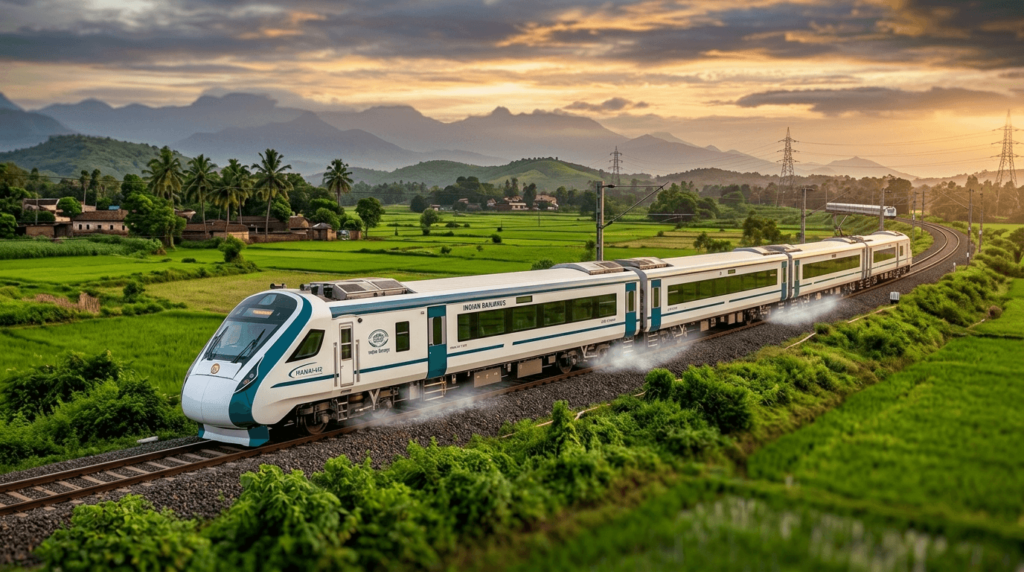
India has officially launched its first hydrogen-powered train, marking a major milestone in sustainable transportation. Operating on the Jind–Sonipat route in Haryana, this zero-emission train uses advanced hydrogen fuel cell technology instead of diesel, producing only water vapor as a byproduct.
But how does it actually work? What is the ticket price? Is it safe? And why is it considered the future of Indian Railways?
Here’s everything you need to know.
The Route and Ride Experience: Where Can You Catch It?
Instead of debuting on a high-profile, premium metro corridor, this pilot project is tackling a crucial regional route.
- The Route: The train currently operates on the 89-km Jind–Sonipat section in Haryana, managed by the Northern Railway.
- Speed: It glides along at a comfortable operational speed of 75 km/h, though its aerodynamic design and powertrain can support up to 110 km/h.
- Passenger Capacity: The 10-coach trainset is remarkably spacious, capable of carrying roughly 2,600 passengers per trip.
- Fares: If you think cutting-edge green tech comes with a premium price tag, think again. Early reports suggest ticket prices range between an incredibly affordable ₹5 and ₹25.
How Does a Hydrogen Train Actually Work?
If you are wondering how water vapor replaces diesel exhaust, it all comes down to the mechanics of hydrogen fuel cells. For those who appreciate the engineering behind the machine, here is exactly what happens under the hood (or rather, on the roof):
- The Fuel Cell Reaction: The train’s roof houses high-pressure storage tanks filled with compressed hydrogen. This hydrogen is channeled into a Proton Exchange Membrane Fuel Cell (PEMFC), where it mixes with oxygen drawn from the outside air.
- Generating Electricity: This chemical reaction strips electrons from the hydrogen atoms, producing a steady flow of electricity that directly powers the train’s traction motors.
- Battery Support: Any excess energy generated doesn’t go to waste. It gets stored in onboard Lithium Iron Phosphate (LFP) batteries. These batteries act as a buffer, providing an extra power boost during initial acceleration and storing regenerative braking energy.
- Zero Emissions: The only byproducts of this entire mechanical process are pure water vapor and heat.
The system generates an impressive 2,400 kW (roughly 3,200 horsepower)matching the pure pulling muscle of traditional diesel-electric trains, but completely eliminating the pollution.
Refueling and Safety: The “Behind the Scenes” Infrastructure
Running a hydrogen train isn’t just about building a new locomotive; it requires engineering a massive supporting ecosystem.
To keep this green machine moving, India has constructed its largest railway hydrogen storage and refueling facility in Jind, capable of storing nearly 3,000 kg of hydrogen.
But is highly combustible hydrogen safe for public transit? Absolutely. The Indian Railways and the Research Design and Standards Organisation (RDSO) have integrated redundant safety mechanisms throughout the trainset:
- Smart Detection: Continuous hydrogen leak detection, heat sensors, and flame monitors operate 24/7 across all coaches.
- Instant Cut-off: Automatic shut-off valves instantly isolate and cut the gas supply if they detect abnormal heat or smoke.
- Emergency Controls: An emergency operating mode allows the loco pilot to move the train safely out of harm’s way if an incident occurs on the tracks.
Why This Matters for India’s Future
India’s launch places it in an elite club of nationsalongside Germany, Japan, and the United Statesthat are successfully operating hydrogen-powered rail systems.
This isn’t just a flashy pilot project. It aligns perfectly with the National Green Hydrogen Mission and India’s aggressive goal to achieve net-zero carbon emissions by 2070. By systematically replacing diesel on non-electrified routes, Indian Railways can drastically cut down air and noise pollution while reducing reliance on imported fossil fuels.
Conclusion and Actionable Takeaways
India’s first hydrogen-powered train is more than a technological milestoneit is a tangible glimpse into the future of eco-friendly, accessible public transit. It proves that sustainability doesn’t have to compromise on mechanical power or passenger affordability.
Key Takeaways:
- Plan a Trip: If you are anywhere near Haryana, grab a ticket on the Jind–Sonipat route to experience emission-free travel firsthand.
- Track the Tech: Keep an eye on the Indian Railways’ expansion plans. If this pilot succeeds, we could see hydrogen trains replacing diesel locomotives on regional routes nationwide.
- Think Green: As infrastructure evolves, this shift toward zero-emission technology highlights the massive opportunities for clean energy integration across India.
Frequently Asked Questions
Where does India’s first hydrogen train run?
The train currently operates on the 89-km Jind–Sonipat route in Haryana.
What fuel does the train use?
It runs on hydrogen stored in high-pressure tanks.
What is the ticket price?
Current fares range between ₹5 and ₹25.
What is the maximum speed?
Operational speed is 75 km/h while the design supports up to 110 km/h.
Does it produce pollution?
No.
The only emission is water vapor.