Introduction: The City That Couldn’t Breathe
Picture Belgrade on a winter morning.
A thick haze sits over the city. Commuters pull scarves over their mouths as they rush past bus stops. Children wait for school buses while invisible particles of pollution settle into their lungs. Air quality monitors flash warnings. And everywhere you look concrete, steel, asphalt there’s barely a patch of green in sight.
This isn’t just a Belgrade problem. Cities from Delhi to Los Angeles, São Paulo to Beijing are choking. The World Health Organization estimates that 9 out of 10 people worldwide breathe air that exceeds safe pollution limits. Urban spaces where more than half of humanity now lives are the worst affected.
We’ve always known the answer is more green. More trees, more parks, more nature woven into the fabric of cities. But here’s the uncomfortable truth: many cities simply don’t have the space, the soil, or the time to wait decades for trees to grow.
So what if the answer wasn’t a tree at all but something living inside a tank of water, no bigger than a park bench?
Meet the algae tree one of the most quietly revolutionary green technologies of our generation. It looks futuristic. It sounds almost too good to be true. And it might just be one of the most important tools we have in the fight for breathable air.
Let’s dig in.
What Is an Algae Tree?
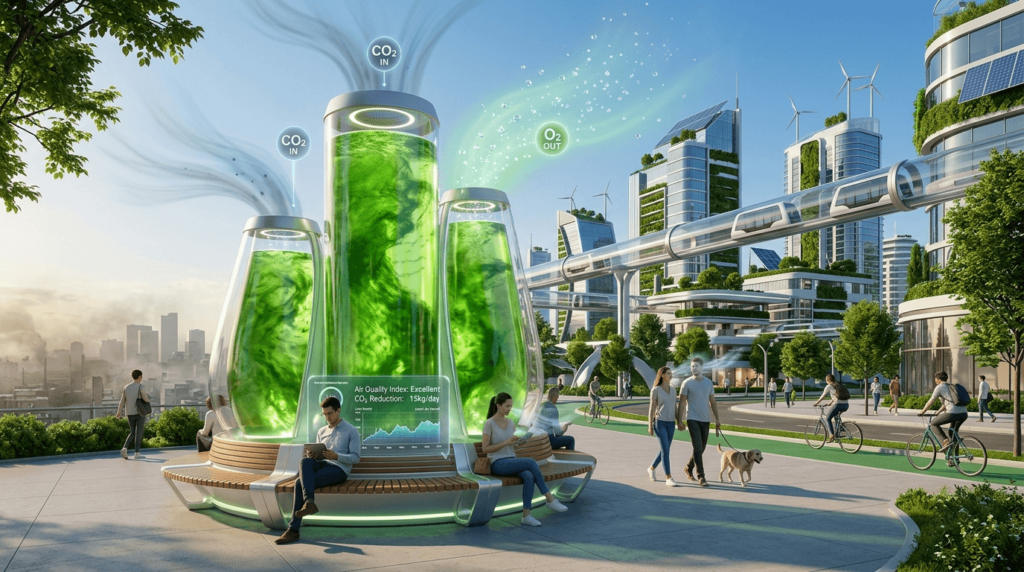
An algae tree also called a liquid tree, urban photobioreactor, or microalgae air purifier is a biotechnology-based system that uses living microalgae suspended in water to absorb carbon dioxide (CO₂) and produce fresh oxygen, mimicking what a tree does but doing it far more efficiently.
The most well-known version is the LIQUID 3 system, developed by Dr. Ivan Spasojević and his team at the Institute for Multidisciplinary Research at the University of Belgrade. First installed in Belgrade in 2020–2021, it received recognition from the United Nations Development Programme (UNDP) and Serbia’s Ministry of Environmental Protection.
At its core, an algae tree is a transparent tank typically holding around 600 liters of water packed with single-celled freshwater microalgae. The tank is mounted on a structure that often doubles as a public bench, making it functional urban furniture as much as a green technology installation.
Unlike a real tree, it doesn’t need soil. It doesn’t need decades to mature. And it starts working from the moment it’s switched on.
In plain terms: An algae tree is what happens when you take the photosynthesis process out of a tree and put it into a high-performance, space-efficient bioreactor that can live on a street corner.
How Does an Algae Tree Work?
The science behind algae trees is elegantly simple even if the engineering behind them is not.
Here’s a step-by-step breakdown of what’s actually happening inside that glowing green tank:
Step 1: Air Intake
The system draws in surrounding air including CO₂ from traffic, industry, and human respiration either through passive exchange or a small pump that bubbles air through the liquid medium.
Step 2: Microalgae Photosynthesis
The microalgae inside the tank typically single-celled species like Chlorella vulgaris or Scenedesmus absorb the CO₂ from the incoming air. Using sunlight (or supplemental LED light in low-light environments), they convert CO₂ and water into glucose for their own growth.
This is photosynthesis the same process trees use. But here’s where algae trees pull ahead dramatically.
Step 3: Oxygen Output
As the algae photosynthesize, they release pure oxygen back into the surrounding environment. And they do this continuously, day after day, with no seasonal dormancy, no leaf drop, no drought vulnerability.
Step 4: Biomass Harvesting
Every four to six weeks, the algae biomass is harvested the “excess” algae that has grown during the cycle. This biomass isn’t waste. It’s used as organic fertilizer, fed back into agricultural soil or urban gardens. The tank is then refreshed with water and nutrients to start the cycle again.
The whole system is designed to be low-maintenance, circular, and self-sustaining a closed loop of growth, harvest, and renewal.
Types of Algae Trees
Not all algae trees look the same or work the same way. The technology has evolved into several distinct formats:
1. Urban Photobioreactor Benches (LIQUID 3 Style)
The original format transparent tanks mounted on structural frames that double as public seating. Compact footprint (roughly 2 ft × 3 ft), installed in plazas, sidewalks, and transit stops.
2. Building-Integrated Photobioreactors (BIPBR)
Algae panels integrated directly into building facades. These systems turn entire walls into living, CO₂-absorbing surfaces while providing natural insulation. Researchers and architects in Spain have been pioneering this approach, embedding flat-plate photobioreactor modules into building designs.
3. Indoor Algae Air Purifiers
Smaller, home and office-scale units like the AIReactor by EcoLogicStudio or the VAYU by AlGreen Tech. These are essentially countertop or wall-mounted photobioreactors, bringing algae-based air purification indoors. The AIReactor, for example, captures roughly the same amount of CO₂ as a mature tree while producing up to 7 grams of dry algae daily.
4. Large-Scale Urban Installations
Industrial-scale photobioreactors designed for parks, transit hubs, or campuses like India’s first prototype unveiled by Kerala University of Fisheries and Ocean Studies (KUFOS) and Lo Carbon Solutions in November 2024, which featured a 1,000-liter transparent tank system.
5. Artificial Tree Designs
Architectural structures inspired by tree aesthetics branching forms covered in photobioreactor modules that mimic the look of a tree while functioning as CO₂ capture systems. Researchers have documented designs using Scenedesmus algae that can capture 50 kg of CO₂ annually per unit while generating 28 kg of usable biomass.
Benefits of Algae Trees
This is where things get genuinely impressive. The case for algae trees goes well beyond “they clean the air.”
🌿 Extraordinary CO₂ Efficiency
This is the headline benefit. According to researchers at the University of Belgrade, microalgae are 10 to 50 times more efficient at fixing CO₂ than trees. One species, Chlorella vulgaris, has been shown to be up to 400 times more effective at harvesting CO₂ than terrestrial plants, according to biotechnology company Hypergiant Industries.
A single LIQUID 3 unit is equivalent to the CO₂-binding capacity of two 10-year-old trees or 200 square meters of lawn.
📐 Space Efficiency
A standard algae tree installation occupies roughly the footprint of a park bench. Compare that to the space, soil depth, and root clearance required to plant even a small tree in a city street. For densely built urban environments with underground infrastructure and concrete everywhere, this is a genuine game-changer.
⚡ Immediate Impact
A newly planted tree might take 10–20 years to reach meaningful CO₂ absorption capacity. An algae tree starts working from day one.
♻️ Zero-Waste, Circular Output
The harvested algae biomass becomes organic fertilizer feeding back into food production or urban greening efforts. Some systems also produce high-value bioproducts like spirulina, omega-3 oils, and biofuels, creating a genuine circular bioeconomy at the city level.
🧠 Smart City Integration
Modern algae tree systems are increasingly equipped with IoT sensors for real-time air quality monitoring, automated nutrient dosing, and performance analytics. They can feed live data into city management platforms making urban air quality visible and manageable in ways traditional trees never could.
💚 Mental & Physical Health Co-Benefits
Beyond CO₂ capture, algae trees contribute to visible urban greenery, reduce the urban heat island effect slightly, and create biophilic touchpoints in concrete-heavy environments. Research consistently shows that exposure to living green elements, even technological ones improves mental well-being.
Algae Trees vs. Traditional Trees: An Honest Comparison
Let’s be direct: this isn’t a competition. Algae trees aren’t trying to replace forests. But it’s worth understanding where each excels.
| Feature | Algae Tree | Traditional Tree |
| CO₂ efficiency | 10–50× higher per unit area | Lower (but cumulative over lifespan) |
| Space required | Minimal (bench-sized) | Significant (soil, root space, canopy) |
| Time to full function | Immediate | 10–20+ years |
| Maintenance | Low (harvesting every 4–6 weeks) | Moderate (pruning, watering, disease) |
| Biodiversity support | None | High (habitat, food, ecosystem) |
| Soil health | None (no soil contact) | Significant positive impact |
| Flood prevention | None | Yes (root absorption) |
| Urban heat reduction | Minimal | Significant (shade, transpiration) |
| Cost | Higher upfront | Lower (varies) |
| Scalability in dense cities | Excellent | Limited |
| Biomass/byproduct value | High (fertilizer, bioproducts) | Limited |
The honest verdict: Traditional trees remain irreplaceable for biodiversity, ecosystem services, flood prevention, shade, and long-term carbon storage. Algae trees fill a critical gap in the places where traditional trees simply cannot go the dense, paved, infrastructure-packed core of modern cities.
Think of algae trees as a complement to nature, not a replacement for it.
Role in Smart Cities and Urban Sustainability
Algae trees aren’t just air purifiers they’re pieces of a larger puzzle that smart city planners are assembling right now.
Here’s how they fit into the broader urban sustainability ecosystem:
Real-time air quality infrastructure. IoT-enabled algae trees can monitor PM2.5, CO₂, temperature, and humidity continuously feeding data to city dashboards and enabling dynamic, data-driven environmental management.
Circular urban bioeconomy. When biomass harvests are fed into urban agriculture (rooftop farms, community gardens), algae trees become a node in a closed-loop food and energy system. Some systems are being explored for biomethane production, turning the harvested algae into clean energy.
Transit hub integration. Installing algae trees at bus stops and metro stations where pollution concentrations peak and open space is almost zero could meaningfully improve the air quality experienced by millions of daily commuters.
Climate adaptation resilience. As cities face increasing pressure to meet carbon-neutral targets, algae trees offer a deployable, measurable, and scalable tool for hitting local emissions reductions. Unlike tree-planting campaigns (which take decades to show results), algae installations deliver verifiable CO₂ data immediately.
Biophilic urban design. Smart cities of the future aren’t just efficient they’re livable. Algae trees contribute to what urban designers call “biophilic design”: the integration of living systems into built environments for psychological and physiological human benefit.
Challenges and Limitations
Let’s be honest about the headwinds too because any technology worth taking seriously deserves a clear-eyed look at its limitations.
💰 Higher Upfront Costs
Building and installing a photobioreactor is more expensive than planting a tree. While operational costs are relatively low, the capital investment is a barrier for cities with limited green infrastructure budgets.
🌡️ Temperature Sensitivity
Microalgae are resilient but not invincible. Extreme cold or heat can slow growth or damage cultures. This requires monitoring and, in some climates, temperature management adding complexity to maintenance.
☀️ Light Dependency
Like all photosynthetic organisms, algae need light. In high-latitude cities with limited winter sunlight, supplemental LED lighting may be required which adds energy consumption to the equation.
🌳 Can’t Replace Ecosystem Services
This is the most important limitation to acknowledge. Algae trees can’t prevent flooding. They don’t cool streets through shade and transpiration the way a mature tree canopy does. They don’t support birds, insects, or biodiversity. They don’t enrich soil. Real trees and real forests do all of these things, and no algae reactor can replicate a complex ecosystem.
🔬 Still Mostly at Pilot Scale
While the results from Belgrade, India, and other projects are genuinely exciting, the honest truth is that most algae tree deployments are still pilot or proof-of-concept installations. Long-term, large-scale urban deployment data is still being collected. We’re still learning.
⚙️ Maintenance Requires Expertise
Harvesting algae biomass, managing nutrient levels, and ensuring culture health requires trained personnel more so than watering a tree. As the technology scales, this will need to be addressed through automation and standardized maintenance protocols.
The Future of Algae Trees
The trajectory of this technology is unmistakably upward and the next five to ten years could be transformative.
Smarter systems. The integration of AI and IoT into photobioreactor management is already underway. Future systems will self-regulate nutrient levels, light exposure, and CO₂ intake automatically becoming truly set-and-forget urban infrastructure.
Architectural integration at scale. As more architects and urban planners embrace biophilic design, building-integrated photobioreactors will move from experimental to standard. Imagine entire city blocks where building facades are living, breathing algae panels.
New revenue streams. The biomass harvested from urban algae trees is increasingly valuable. Spirulina, bioplastics, pharmaceutical compounds, biofuels, and high-protein food additives are all derivable from algae cultures. This transforms algae trees from a cost center into a revenue-generating piece of urban infrastructure.
Global urban deployment. With cities in South Asia, Southeast Asia, and Africa facing the world’s worst urban air quality, scalable and affordable versions of algae tree technology could have an enormous public health impact. India’s 2024 prototype is just the beginning.
Hybrid green infrastructure. The future isn’t algae trees or real trees it’s both, thoughtfully integrated. Parks with traditional trees and walking paths punctuated by algae tree installations. Transit corridors lined with photobioreactor benches. Rooftops combining green plant walls with algae panels. A layered, resilient urban green ecosystem.
As climate pressure intensifies and the window for meaningful action narrows, algae trees represent something rare: a technology that already works, is already deployed, and is already improving lives while still having enormous room to grow.