
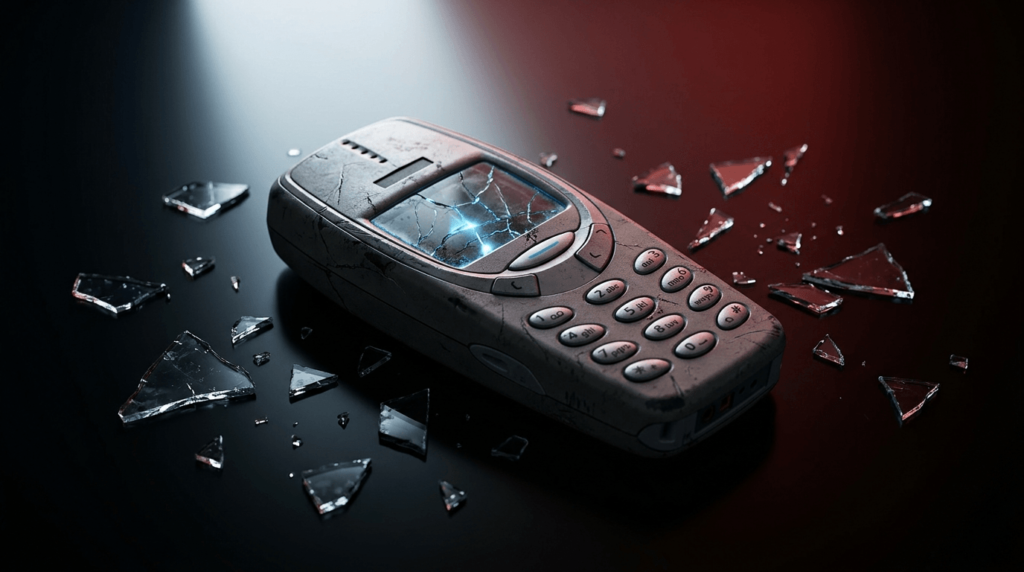
There’s a good chance the first phone you ever owned wasn’t a smartphone. It was a brick. Indestructible, boring-looking, and somehow still in a drawer at your parents’ house today, still turning on after a decade of neglect. It was probably a Nokia.
At its peak, Nokia wasn’t just a phone brand it was the phone industry. In 2007, nearly one out of every two phones sold on the planet was a Nokia. The company’s annual budget was bigger than the Finnish government’s. Finnish teenagers grew up assuming Nokia would always be there, the way Americans assumed the same about Kodak or Blockbuster.
Then, in a stretch of time shorter than most people spend at a single job, it all came apart. By 2013, Nokia’s share of the smartphone market had fallen from roughly 50% to under 5%. A year later, the company that had defined mobile phones for two decades sold its entire phone business to Microsoft and within another two years, Microsoft had written the whole thing off as a near-total loss.
So what actually happened? Not the one-line version you’ve heard (“they missed the iPhone”), but the real story the decisions, the missed windows, and the internal culture that turned the world’s most dominant tech company into a cautionary tale taught in business schools. Let’s walk through it.
From Paper Mill to Phone Giant: Nokia’s Unlikely Origin
Nokia wasn’t built as a phone company. It wasn’t even built as a tech company. It started in 1865 as a wood pulp mill on the banks of a river in Tampere, Finland, founded by a mining engineer named Fredrik Idestam.
Over the following century, Nokia turned into something closer to a Finnish conglomerate than a focused business at various points it made rubber boots, toilet paper, tires, and cables, alongside a growing electronics division. That electronics arm is where things get interesting. By the 1970s and 80s, Nokia was dabbling in radio telephones, and under CEO Kari Kairamo in the 1980s, the company grew aggressively through acquisitions across Europe.
The real turning point came in the early 1990s. Nokia bet heavily on GSM the digital mobile standard that Europe was adopting as its wireless backbone right as the technology was about to explode globally. That single bet is arguably the most important decision in the company’s history. It positioned Nokia at the center of a wave that was about to turn mobile phones from a luxury item into something every person on Earth would eventually carry.
The Golden Years: When Nokia Owned the World
Once GSM took off, Nokia didn’t just participate in the mobile boom it defined it. Between 1996 and 2001 alone, the company’s turnover exploded from roughly £6.5 billion to £31 billion. This wasn’t slow, steady growth. It was one of the fastest scale-ups in the history of consumer electronics.
What made Nokia phones so beloved wasn’t cutting-edge features it was the opposite. They were simple. They were nearly indestructible. Battery life was measured in days, not hours. The interface made sense to a first-time user in about thirty seconds. And the design language, especially through phones like the Nokia 3310, became genuinely iconic the kind of object people still get nostalgic about decades later.
By 2007, Nokia’s dominance had reached a level almost no consumer brand has matched since: a 49.4% share of the entire global mobile phone market. Not the smartphone market the whole market. Every second phone sold on Earth had the Nokia logo on it.
The company wasn’t standing still on the software side either. In 2002, Nokia released the 7650, one of the earliest phones with a built-in camera and color screen. In 2007, the N95 arrived a genuinely ambitious multimedia device with GPS, a solid camera, and a slide-out design, built on Nokia’s own Symbian operating system. On paper, Nokia looked unstoppable: the biggest market share, the strongest brand, real R&D investment, and a track record of innovation stretching back over a decade.
And then, almost unnoticed at first, everything changed.
2007: The Year Nokia’s World Quietly Ended
Two things happened in 2007 that, in hindsight, marked the beginning of the end.
Apple launched the iPhone. Nokia’s own CEO at the time, Olli-Pekka Kallasvuo, was reportedly dismissive, suggesting the company had nothing to worry about. It’s easy to laugh at that now, but at the time it wasn’t an unreasonable read the first iPhone was expensive, had no app store yet, ran on slow 2G networks, and Nokia genuinely did have more experience building phones than anyone on Earth. The mistake wasn’t underestimating the first iPhone. It was underestimating the idea of the iPhone: a touchscreen computer that happened to make calls, versus a phone that happened to have some smart features bolted on.
Google released Android, open-source and free for any manufacturer to use. This mattered just as much as the iPhone, maybe more. It meant Samsung, HTC, Motorola, and every other Nokia competitor suddenly had access to a modern, touch-first operating system without having to build one from scratch. Nokia had spent years building Symbian internally now its biggest rivals could skip that entire investment.
Nokia’s response to both of these threats was, essentially, to keep doing what had worked before: iterate on Symbian, keep shipping hardware, and assume its brand loyalty and market share would buy it time. That assumption turned out to be the costliest one in the company’s history.
Why Nokia Didn’t Just… Copy the iPhone
This is the question everyone asks, and the honest answer is: it’s not that simple, and that’s exactly the lesson.
Symbian wasn’t built for touch. It was designed in an era of physical keypads and small monochrome-adjacent screens. Retrofitting a decade-old operating system to behave like a modern touchscreen OS is enormously harder than building one from scratch which is exactly what Apple and Google had done.
Nokia had a second, competing internal project. Rather than committing fully to fixing Symbian, Nokia was simultaneously developing an entirely separate operating system called MeeGo. Splitting engineering resources and strategic focus across two platforms one legacy, one new meant neither got the full commitment it needed. When the MeeGo-based Nokia N9 finally launched in 2011, it received genuinely strong reviews and real consumer interest. It also arrived at almost the exact same moment Nokia’s new CEO declared the platform dead.
Success bred internal caution, not urgency. When you hold 50% of a market, the instinct is to protect that position, not to blow up your own product line and start over. That instinct is rational in a stable market. In a market being reinvented from the ground up, it’s fatal. This is the same trap that caught Kodak, Blockbuster, and BlackBerry Nokia is simply the version of the story with the biggest numbers attached.
The “Burning Platform” Memo That Set Everything on Fire
In September 2010, Nokia brought in Stephen Elop as CEO notably, its first non-Finnish leader, and a former Microsoft executive who had run the division that included Microsoft Office.
Five months into the job, in February 2011, Elop sent an internal memo to Nokia staff that would become one of the most infamous documents in corporate history. It leaked almost immediately. In it, Elop compared Nokia to a man standing on a burning oil platform, forced to make a desperate jump and bluntly told employees that Nokia had shipped nothing close to the iPhone experience since 2007, and that Android had just overtaken Nokia in smartphone volume.
The memo wasn’t wrong, exactly. But the timing and the delivery were close to catastrophic. Elop announced that Nokia was abandoning both Symbian and MeeGo in favor of an exclusive partnership with Microsoft’s Windows Phone publicly killing the company’s current product line before a single Windows Phone device was ready to ship.
Put yourself in a customer’s shoes at that moment: Nokia’s own CEO had just told the world, in effect, “don’t buy our current phones the good stuff is still six-plus months away.” Sales of existing Nokia phones collapsed almost immediately. By some estimates, the company lost close to half its remaining market share within two quarters. It’s since been nicknamed a real-world example of the “Osborne effect” when announcing a future product kills sales of the current one, taking the whole company down with it.
The Windows Phone Bet That Never Paid Off
Nokia’s Lumia line, running Windows Phone, launched with genuinely well-reviewed hardware. Critics liked the cameras, liked the build quality, liked the design. The problem wasn’t the phones. It was the ecosystem around them.
Smartphones aren’t really sold on hardware alone anymore they’re sold on the apps available for them. And app developers won’t invest time building for a platform with a small user base, while customers won’t buy a phone whose app store is missing everything they use daily. It’s a chicken-and-egg trap, and Windows Phone never escaped it. Nokia ended up making over 80% of all Windows Phone devices sold, which meant Nokia’s fate and Windows Phone’s fate became the same fate and neither could break out of third place behind iOS and Android.
By 2013, Nokia’s global smartphone market share, which had stood near 50% just six years earlier, had fallen below 5%.
The Sale to Microsoft and the Quiet Ending
In September 2013, Microsoft announced it was buying Nokia’s devices and services division for roughly $7.2 billion (final figures after adjustments landed closer to $7.5 billion). Stephen Elop returned to Microsoft as part of the deal, walking away with an exit package worth an estimated $25 million a detail that did not go over well in Finland, given what had happened to the company under his leadership.
Microsoft’s plan was to fuse Nokia’s manufacturing scale with its own software ambitions and make a real third mobile ecosystem happen. It didn’t work. Within two years, Microsoft wrote off the entire acquisition around $7.6 billion and laid off roughly 18,000 former Nokia employees. Windows Phone was effectively dead not long after.
Nokia Today: Not Actually Dead, Just Not a Phone Company
Here’s the part most people don’t know: Nokia, the company, still exists and it’s doing fine. It simply isn’t a phone company anymore.
After selling its devices business, Nokia refocused entirely on telecom infrastructure the networking equipment, 5G technology, and patents that power the world’s mobile carriers, largely invisible to consumers but essential to how phones actually connect to networks. It also acquired Alcatel-Lucent, gaining ownership of the legendary Bell Labs, and remains one of the largest patent holders in mobile technology, earning ongoing licensing revenue from nearly every phone manufacturer on Earth, including the ones that beat it.
Meanwhile, the Nokia name lives on in phones again but not made by Nokia. A separate company, HMD Global, licenses the Nokia brand and produces phones under it, a fairly common arrangement in consumer electronics when a brand outlives the original business that built it.
So the honest ending isn’t “Nokia died.” It’s “Nokia’s phone business died, and the parent company quietly rebuilt itself around infrastructure instead” arguably a less dramatic, but more accurate, story than the one usually told.
What Nokia’s Fall Actually Teaches Us
It’s tempting to reduce this whole story to “they got complacent,” and that’s part of it but the more useful lesson is more specific than that:
- Market share is a lagging indicator, not a safety net. Nokia’s 49% share in 2007 measured what had already happened, not what was coming. By the time the share numbers reflected the iPhone/Android threat, the company was already years behind.
- Splitting focus between a legacy product and its replacement rarely works. Running Symbian and MeeGo simultaneously meant Nokia never fully committed to either, right when full commitment was what the moment demanded.
- Public announcements about the future can kill the present. The burning platform memo is a masterclass in how honesty about internal problems, delivered at the wrong moment and to the wrong audience, can accelerate the exact crisis it’s trying to prevent.
- A great hardware business isn’t the same as a great platform business. Nokia could build phones better than almost anyone alive. It couldn’t build (or borrow, successfully) the software ecosystem that phones had quietly become dependent on.
- Being early to a shift matters more than being the biggest player in the old paradigm. Apple and Google weren’t bigger than Nokia in 2007. They were simply building for where the market was going, not where it already was.
Nokia’s story isn’t really about a phone company failing. It’s about what happens to any dominant business in any industry when the rules of the game change faster than the organization’s willingness to change with them. That’s a much more uncomfortable lesson than “they should have made an iPhone clone,” and it’s the one actually worth remembering.